What To Wear On A Kayak Tour In Cool, Wet Weather
Two different operators, two different stretches of water, one shared climate: here is exactly what to wear for a paddle near Franz Josef, based on what each operator actually supplies and asks you to bring.
Short answer
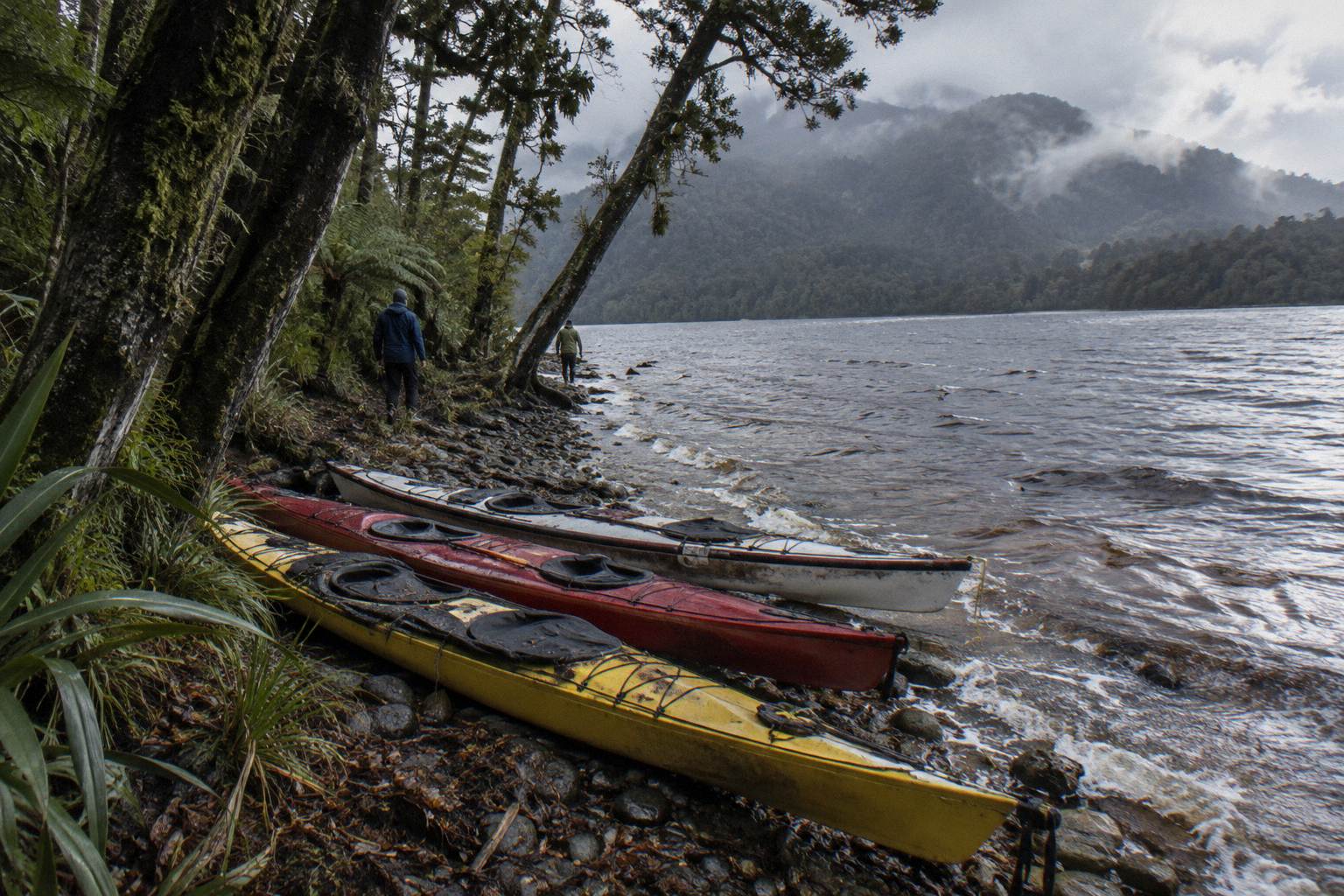
Wear quick-drying layers, a warm top, and comfy sneakers or sandals, because your feet stay dry in the double kayaks on Lake Mapourika. The operator supplies the paddling jacket, PFD, wet-weather gear, skirt and pogies. On Okarito Lagoon you bring your own rain jacket and quick-dry clothing. Leave the jeans at home.
Kayaking near Franz Josef is not a wetsuit sport, and it is not a beach holiday either. The West Coast of New Zealand is one of the wettest inhabited corners of the country, and the operators who paddle here have designed their gear lists around that reality. Both of the local operators hand you most of the specialist equipment before you touch the water, which means the clothing decisions that actually matter are the ordinary ones in your suitcase: your base layers, your footwear, and the pair of jeans that should stay in the hotel room.
Below are the two gear lists in detail, one from Franz Josef Wilderness Tours on Lake Mapourika and one from Okarito Kayaks on Okarito Lagoon, plus the climate context and safety rules that explain why the lists look the way they do. Because the site itself publishes this research rather than any single traveller's diary, every figure here comes from the operators' own pages, official sources, or NIWA climate records, and nothing is guessed. If you are still choosing between the two waters, the comparison of Lake Mapourika against Okarito Lagoon is the companion piece.
What Should You Actually Wear On A Kayak Tour Near Franz Josef?
For a Lake Mapourika tour, wear a warm top layer under the supplied paddling jacket, quick-drying bottoms of any kind except jeans, and comfy sneakers or sandals, because your feet stay dry inside the kayak. For an Okarito Lagoon tour, wear warm quick-drying clothing and bring your own rain jacket, since that operator supplies safety gear but not outer clothing. Neither trip requires a wetsuit.
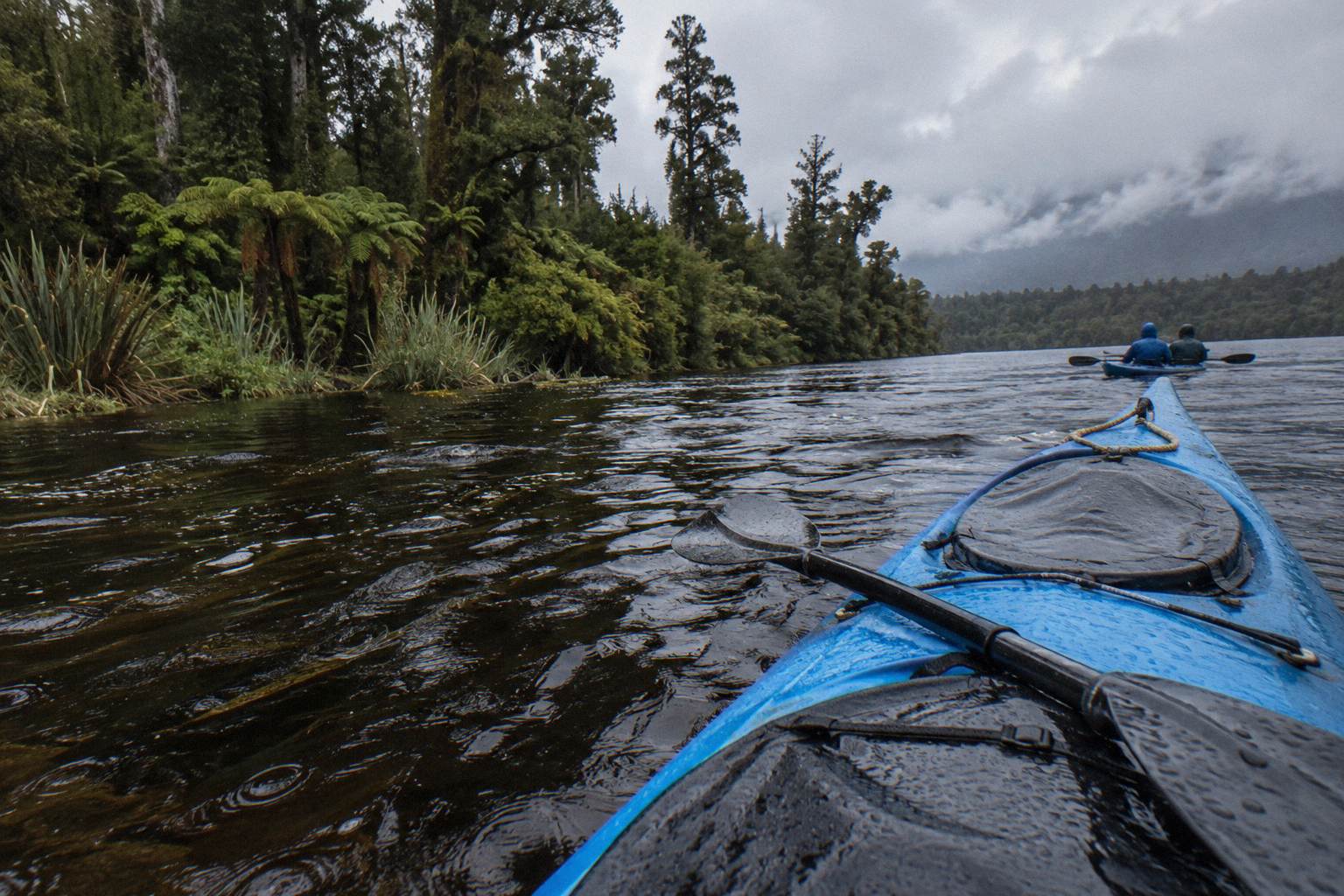
The single most useful thing to understand is that both trips are paddled in stable sit-in kayaks, not in craft where you expect to get soaked. On the lake, Franz Josef Wilderness Tours uses stable double kayaks fitted with spray skirts, and the operator's FAQ is blunt about experience: "You do not need to know how to swim, as a correctly fitted life jacket is worn throughout." On the lagoon, Okarito Kayaks supplies spray skirts and dry bags for the same reason. You dress for sitting still in cool air with wet weather possible, not for swimming.
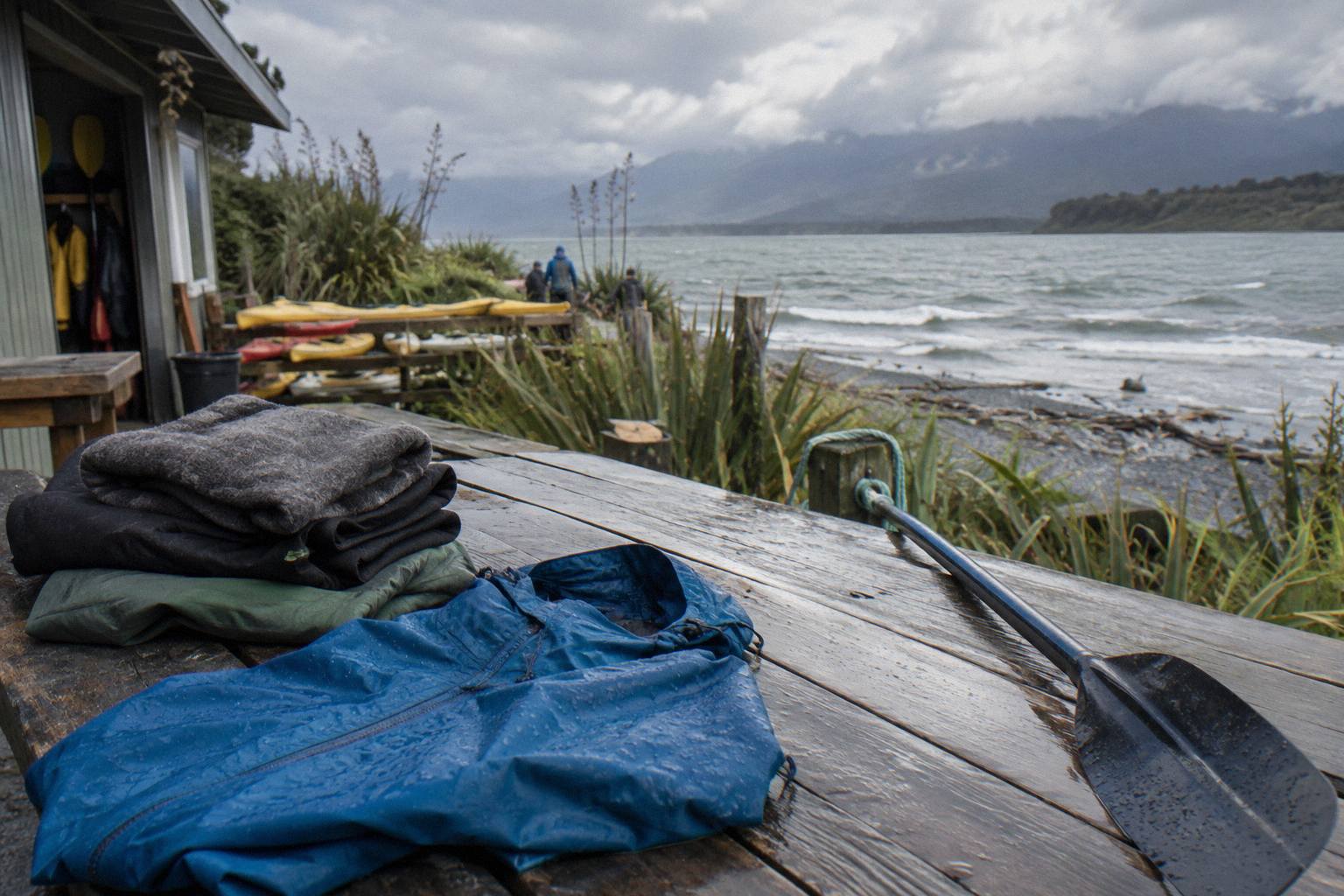
That changes the packing logic completely. Insulation comes first, because wind on open water strips heat fast even on a mild afternoon. Waterproofing matters, but only for your torso and your spare clothes, since the operators cover the boat-side splash protection. Footwear, oddly, is the item people agonise over most and worry about least once they arrive: sneakers or sandals are fine, feet stay dry on the lake trips, and the main rule is simply that they should be comfortable and stay on.
The seasons nudge this advice rather than overturn it. Summer sessions on the lake, from 1 November to 31 March, run at 9am, 1pm and, on the operator's Sunset Classic, 5pm, while winter sessions from 1 April to 31 October shift to mornings and early afternoons, and the times may vary. A 5pm summer departure can end in cooling evening air, so a light spare layer in the dry bag earns its place even in January. The layering principle is identical year round; only the thickness of the layers changes.
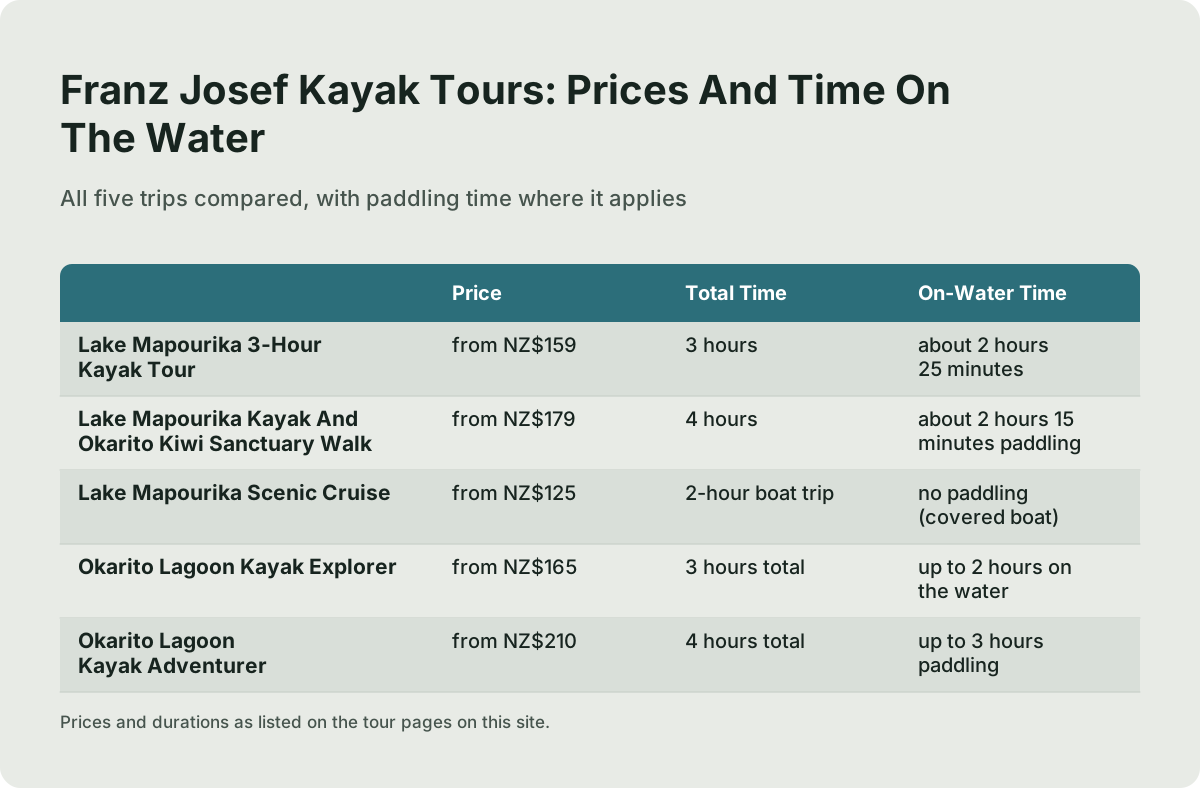
If you have already booked and are counting down the days, the practical starting point is the trip with the most reviews, the Lake Mapourika 3-Hour Kayak Tour, from NZ$159 per person, rated 4.9 from 400+ reviews, with about 2 hours 25 minutes of the 3 hours spent paddling. The longer guide to Lake Mapourika kayaking covers the route in detail.
What Does The Operator Supply, And What Do You Bring?
On the lake trips, Franz Josef Wilderness Tours supplies the dry bag, paddling jacket, PFD, wet-weather gear, kayak skirt, pogies, paddle and free photos, so you bring only a warm top layer, quick-dry bottoms, sneakers or sandals, a cap or sunglasses, and a camera or phone. On the lagoon trips, Okarito Kayaks supplies the buoyancy aid, spray skirt, dry bags, lagoon map, bird guide, repellent and a rescue boat on standby.
The lake list is generous. Pogies alone are a small luxury most first-time paddlers have never heard of: they are neoprene hand covers that slip over the paddle shaft so your bare hands grip the paddle while staying shielded from wind and spray. Between the paddling jacket, the wet-weather gear and the skirt, the operator has the elements covered for light rain, which the operator notes "can be especially atmospheric" from the water.
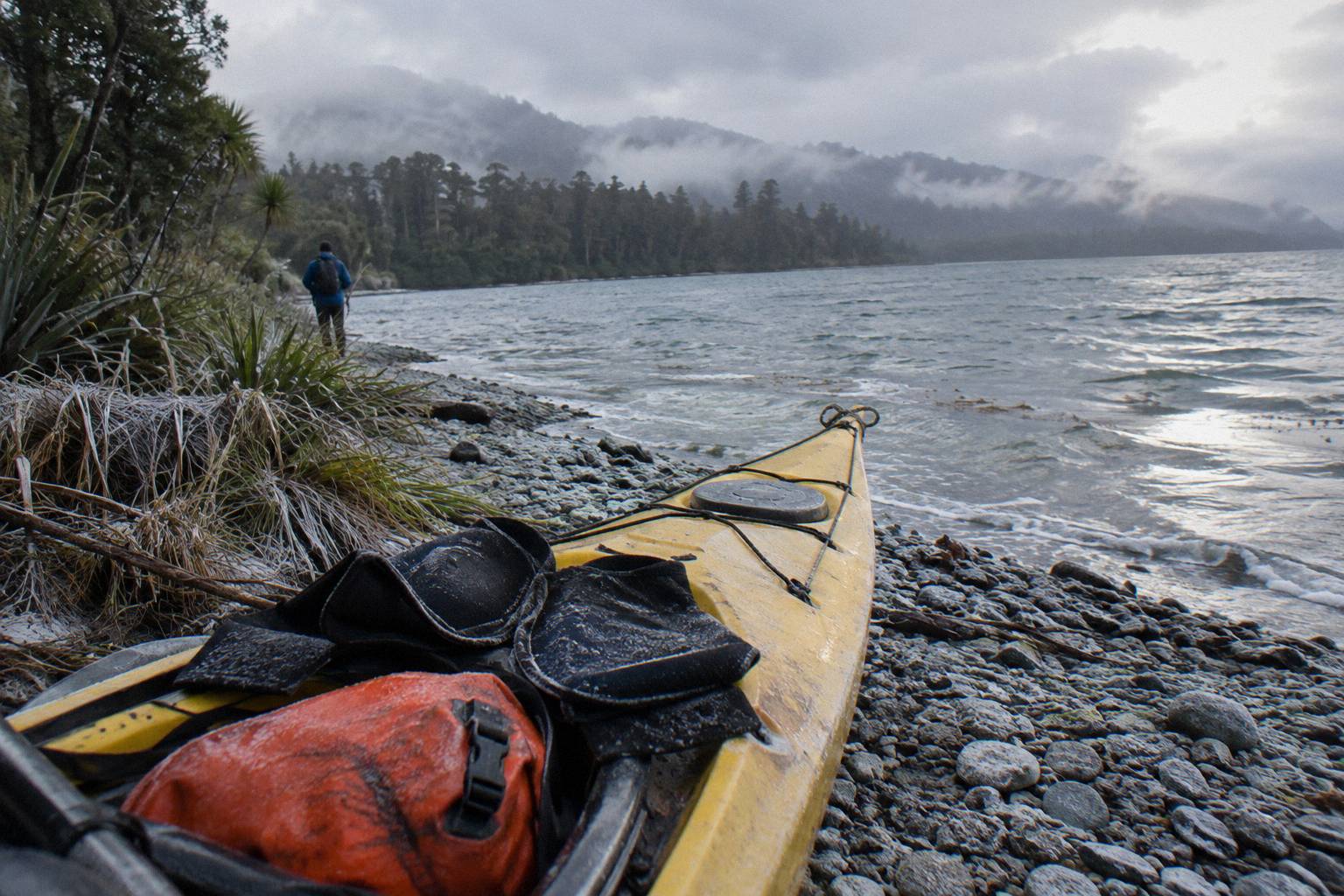
The lagoon list shifts responsibility to you for the outer layer. Okarito Kayaks asks paddlers to bring warm quick-drying clothing, a rain jacket, footwear, water, snacks, sunscreen, a camera and binoculars, and it hands over the safety and navigation kit. Insect repellent is provided on the lagoon, an environmentally friendly one, and the operator mentions sandflies on occasional cloudy, still days. The Lake Mapourika booking page likewise lists sunscreen and insect repellent among its inclusions. DOC's own advice for the wider region is to carry warm and waterproof clothing and repellent because sandflies are prevalent, and its Lake Matheson page warns they can be fierce there.
Here is the two-list comparison in one place:
| Item | Lake Mapourika trips (Franz Josef Wilderness Tours) | Okarito Lagoon trips (Okarito Kayaks) |
|---|---|---|
| Buoyancy aid / PFD | Supplied (worn throughout) | Supplied |
| Splash protection | Paddling jacket, wet-weather gear, kayak skirt | Spray skirt |
| Hand protection | Pogies supplied | Not listed, bring gloves if you run cold |
| Dry storage | Dry bag supplied | Dry bags supplied |
| Navigation / extras | Free photos emailed | Lagoon map, bird guide, binoculars to bring |
| Insect repellent | Listed on the booking page | Environmentally friendly repellent supplied |
| Rain jacket | Supplied | Bring your own |
| Warm layer | Bring your own top layer | Bring warm quick-drying clothing |
| Footwear | Comfy sneakers or sandals, feet stay dry | Bring footwear |
| Food and drink | Not listed | Bring water and snacks |
If your heart is set on the longer day that pairs the paddle with a rainforest walk on a private track reachable only by water, the Lake Mapourika Kayak And Okarito Kiwi Sanctuary Walk runs 4 hours from NZ$179 per person, rated 4.9 from 120+ reviews, with about 2 hours 15 minutes paddling plus about an hour on foot. That walk is the one moment across all five trips where footwear choice earns its keep, since you leave the kayak and stand on a forest track. The operator also suggests hot drinks and a light snack for that trip, which is worth folding into your bag.
For anyone in your group who would rather not paddle at all, the Lake Mapourika Scenic Cruise from NZ$125 per person is a 2-hour covered-boat trip with a toilet on board, complete with the same courtesy transfer from the Franz Josef office, so a non-paddling companion can dress for a boat ride rather than a paddle. The cruise runs rain or shine per its booking page, which makes it the most weatherproof booking of the five and the one where clothing worries genuinely do not apply.
Why Are Jeans The One Banned Item Of Clothing?
Franz Josef Wilderness Tours lists its bottoms rule as "anything but jeans", because denim absorbs water, holds it against your skin, and loses all insulating value when damp, which on a cool lake is a genuine hypothermia risk rather than a comfort problem. Quick-drying synthetics, merino or even ordinary track pants do the job jeans cannot.
The rule reads like a throwaway line on the operator's page, but it is backed by the operator's own risk disclosure, which lists capsize and hypothermia among the risks of the lake, higher in winter. Denim is close to the worst possible fabric in that scenario: it wicks water upward, dries slowly, and clings. The same logic explains the "warm top layer" instruction, since insulation you can add under the supplied jacket is the cheap insurance against a cold headwind mid-lake.
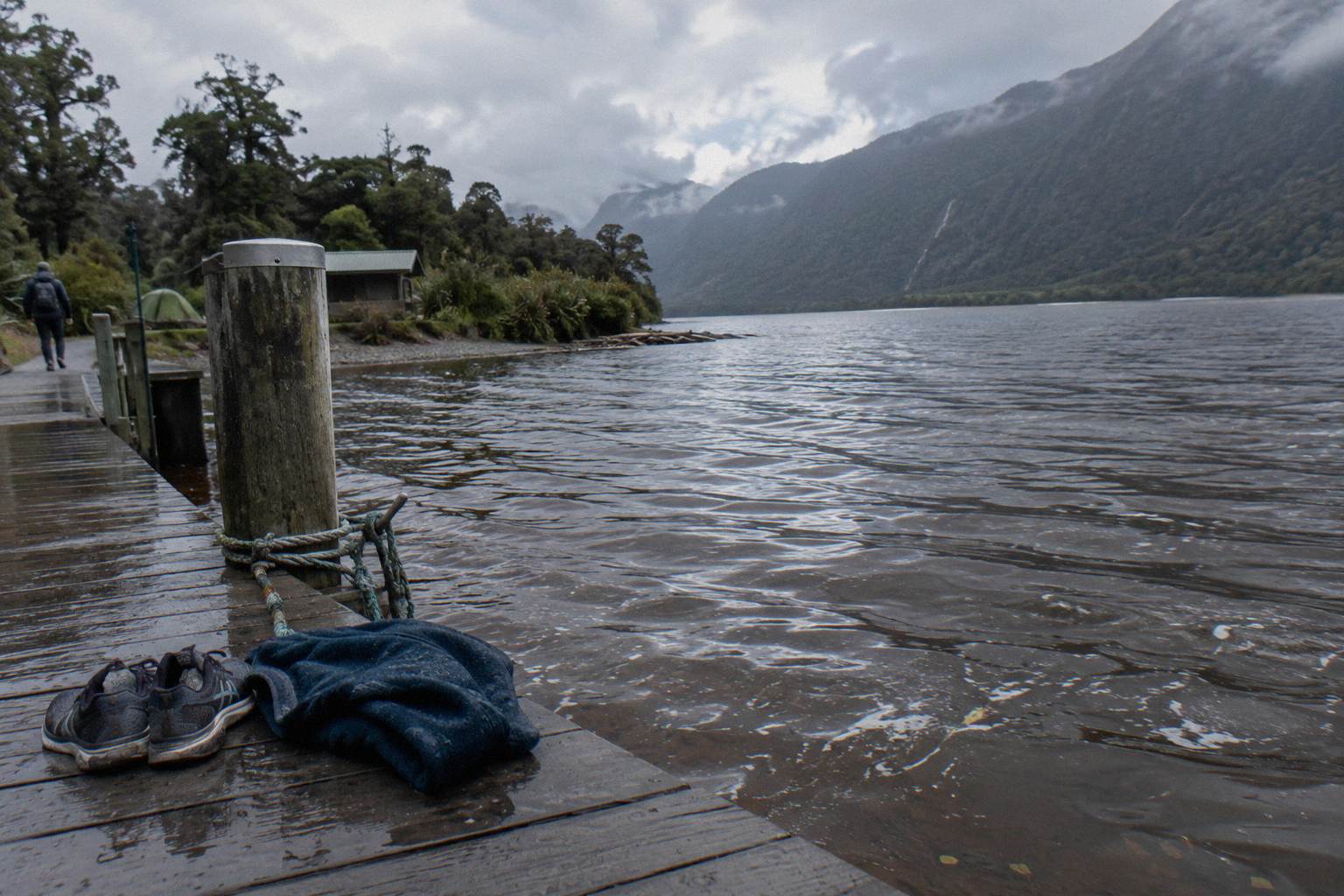
The good news for anyone travelling light is that you almost certainly already own the right clothes. A fleece or merino midlayer, leggings or hiking trousers, and the shoes you wore to the glacier walk will pass both operators' lists. Cotton generally behaves one notch better than denim but still holds moisture, so if you own a synthetic or merino alternative, pack it instead. If you want the fuller argument against denim on the water, the site's piece on wearing jeans on a kayak tour goes through it. For layering logic across the seasons, the guide to what to wear kayaking in changing weather builds on the same NIWA numbers used below.
One quiet advantage of booking any of the lake trips: the courtesy transfer from the Main Road office means you can arrive dressed and stay dressed, with no changing-room logistics at the lake shore at all. Check-in is at 30 Main Road in the township, and the operator asks guests to be there at least 15 minutes early, which is also the moment you get fitted for the jacket and PFD, so wear the layers you want on the water when you walk in the door.
What Should You Wear On The Okarito Lagoon Trips?
For the Okarito Lagoon Kayak Explorer or Adventurer, wear warm quick-drying clothing under a rain jacket you bring yourself, footwear you can walk to the water in, and a warm hat and gloves if you run cold, because the lagoon trips are tide-timed and self-arrival, and Okarito Kayaks supplies buoyancy aids, spray skirts and dry bags rather than outer clothing. Arrive 10 to 15 minutes before start.
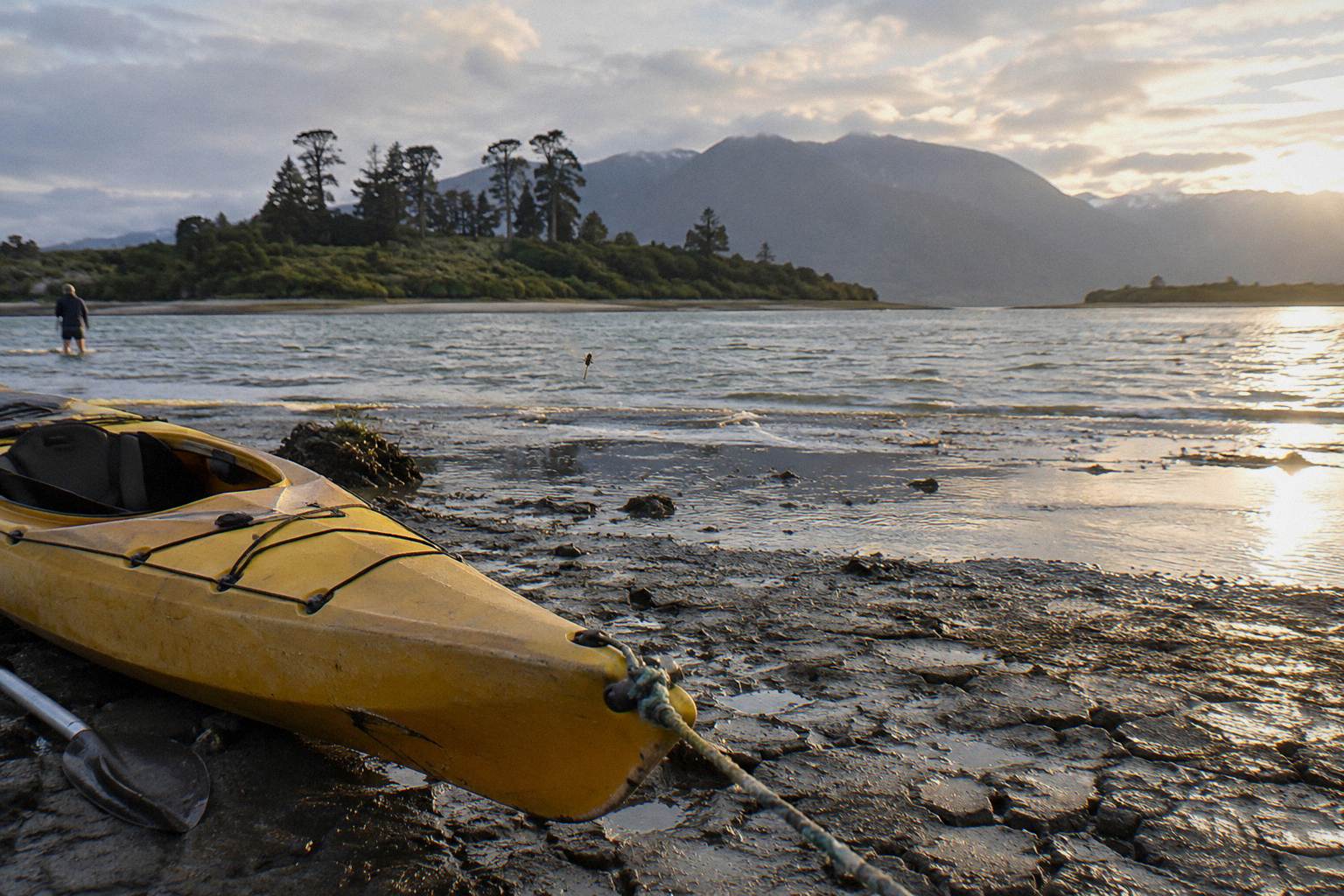
The lagoon experience differs from the lake in three ways that touch clothing. First, you drive yourself to the base at 1 The Strand in Okarito, about 25 minutes north of Franz Josef on a road 10 km off SH6, so you want clothes you can sit in a car in, not clothes you wriggle into at a jetty. Second, the lagoon is shallow and tidal, and start times shift with the best tidal conditions for the day, which can mean an early or midday start rather than a fixed hour. Third, the village has no shop, so a forgotten hat or snack stays forgotten.
The Explorer is 3 hours total with up to 2 hours on the water, from NZ$165 per person; the Adventurer is 4 hours total with up to 3 hours paddling, from NZ$210 per person, and needs some fitness and flexibility. Guided departures need a minimum of two adults booked to confirm, and the booking pages exclude people over 200 cm or over 125 kg. Binoculars earn their place in your bag here: kotuku, the white heron, are commonly seen feeding throughout the lagoon year round, though the nesting colony itself sits inland at Waitangiroto and can only be visited on the separate licensed tour from Whataroa, as the guide to kotuku spotting from a kayak explains.
Because the Adventurer's extra hour is spent further afield, it rewards the more serious layering effort of the two: a proper thermal base under your quick-dry midlayer, and spare warmth in the dry bag. The site's lagoon-focused guide to Okarito Lagoon kayaking covers tides and timing.
How Cold And Wet Is The West Coast, Really?
NIWA records put Franz Josef's mean annual rainfall at 5,555.2 mm, with every single month above 300 mm, and a mean annual temperature of 11.4 °C, so you plan for damp air and cool wind in any season, not for a rare bad day. October is the wettest month at 594.1 mm and July the driest at 317.8 mm.
Those numbers reframe the packing question. There is no dry season here to aim for, and no month where a rain jacket is unnecessary. In practice the trips run in wet weather happily, and the operator on the lake notes that it is often dry at Lake Mapourika while it is raining in the township, a microclimate gap worth knowing before you cancel from your hotel window. If conditions are ever considered unsafe, the operator cancels and offers an alternative or a full refund. More of these guides are collected on Franz Josef Kayak Tours.
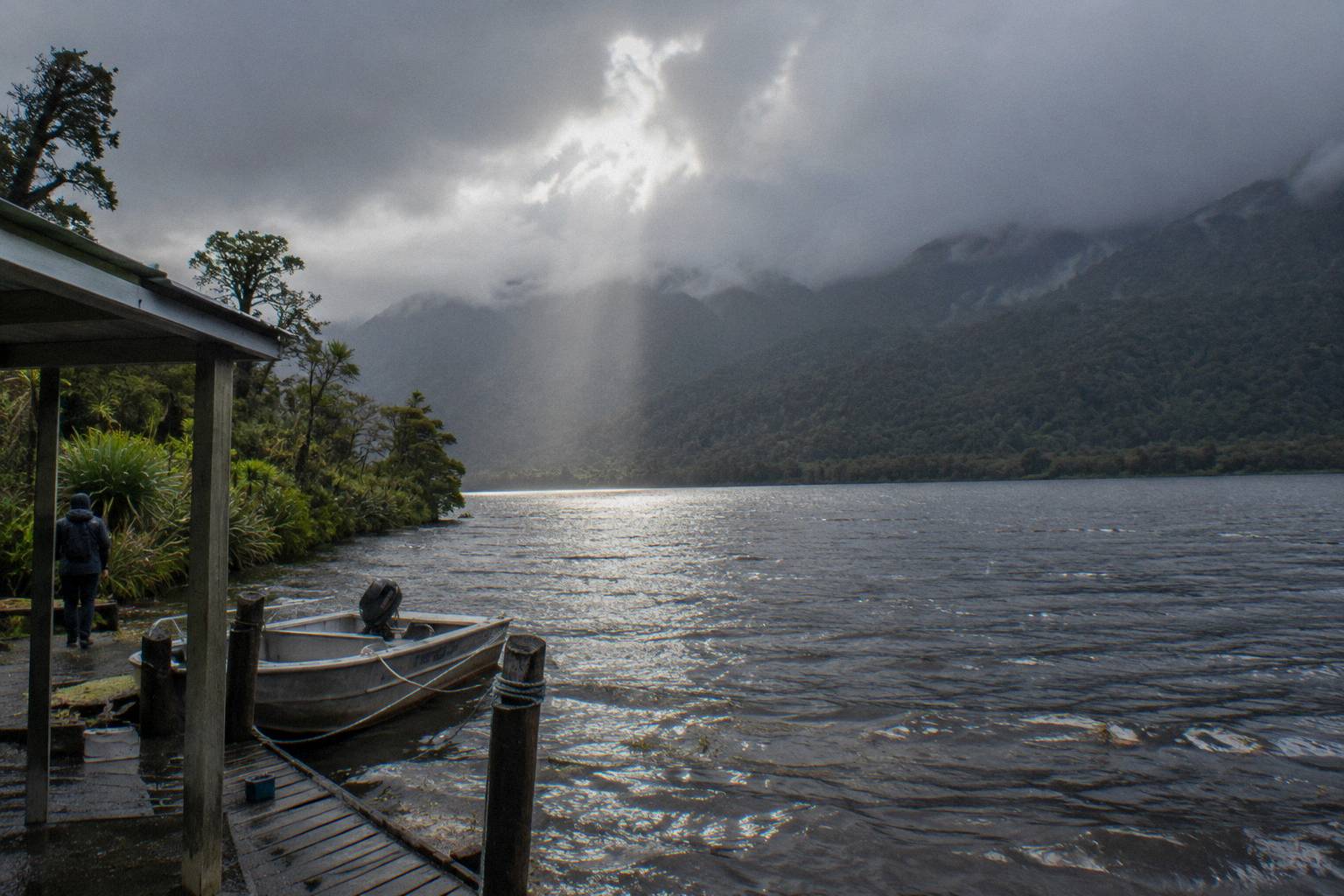
Temperature is mild rather than extreme: mean daily maximums run from 20.5 °C in February down to 11.9 °C in July, and mean daily minimums from 10.5 °C in January to 3.3 °C in July. Sunshine totals about 1,169 hours a year. In summer clothing terms, that is a warm-but-not-hot day with a real chance of a shower, and the operator's summer season runs 1 November to 31 March, when a 5pm departure exists on its Sunset Classic. Winter sessions from 1 April to 31 October run mornings and early afternoons, and the colder minimums make the warm top layer genuinely non-negotiable. December and January sit in the wetter half of the year despite being the warmest, at 593.7 mm and 552.0 mm respectively, which is the exact combination that makes quick-dry fabric worth owning. The full seasonal breakdown is in the best time for West Coast kayaking.
Do You Need To Be Able To Swim, And What Safety Gear Matters?
No, swimming ability is not required on the lake trips, because a correctly fitted life jacket is worn throughout, and the same principle applies on the lagoon where a buoyancy aid is supplied. Since 9 October 2026, lifejackets must be worn underway on any recreational craft 6 m and under nationwide, kayaks included, so the PFD is law as well as policy.
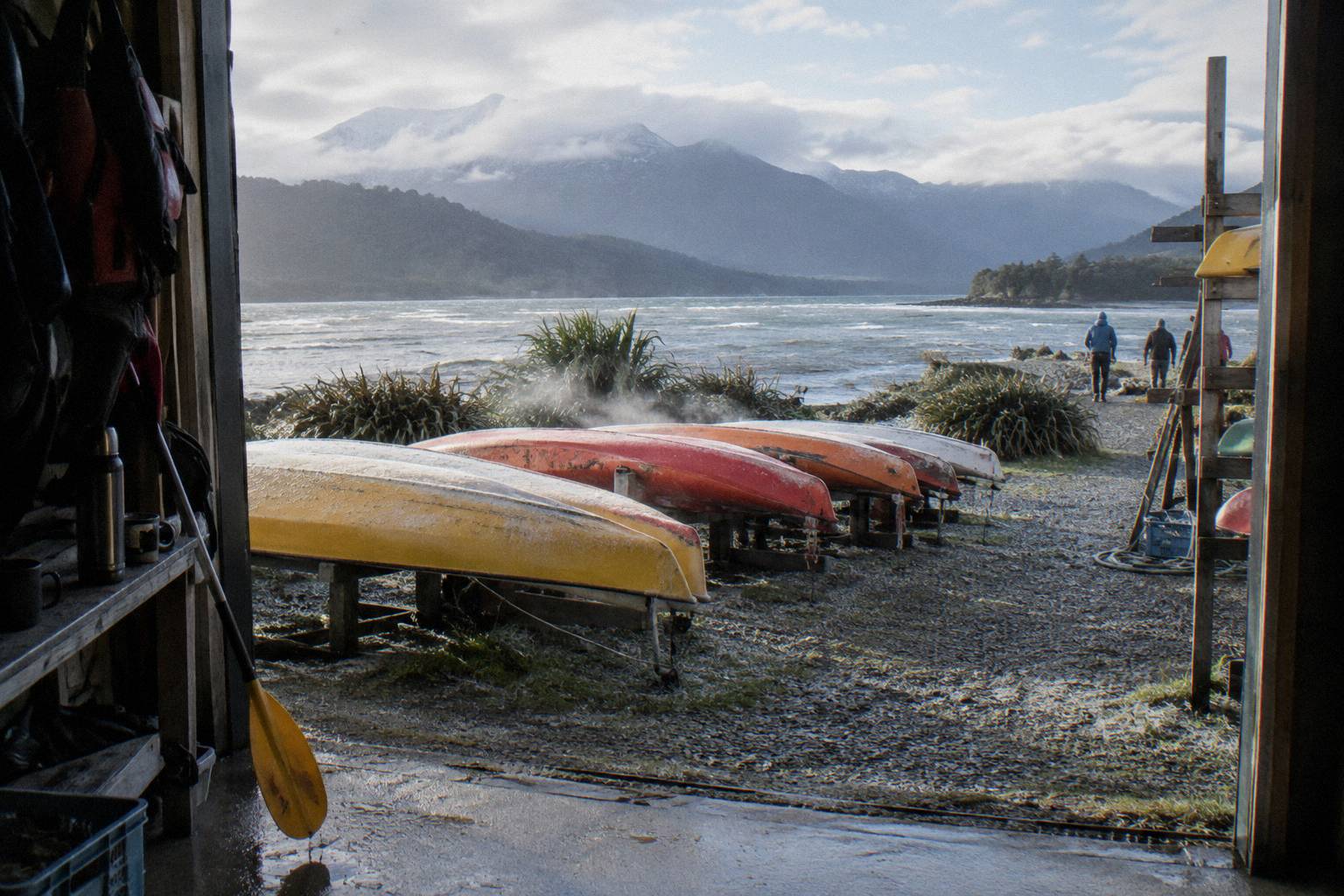
The lake operator's FAQ answers the swim question plainly: previous experience is not needed and the lifejacket is worn the whole time. The operator states its activities are safety audited through AdventureMark and Maritime NZ. Its risk disclosure is equally plain that the lake is deep and exposed, lists capsize, hypothermia and drowning among the risks, and notes that at times you can be 1 to 2 hours from medical assistance. The clothing list above is, in that context, part of the safety system, not a style guide. The disclosure also asks paddlers to declare medical conditions and to skip drugs or alcohol before the tour, and it flags loss of items overboard as a real risk, which is why valuables belong in the dry bag rather than loose pockets.
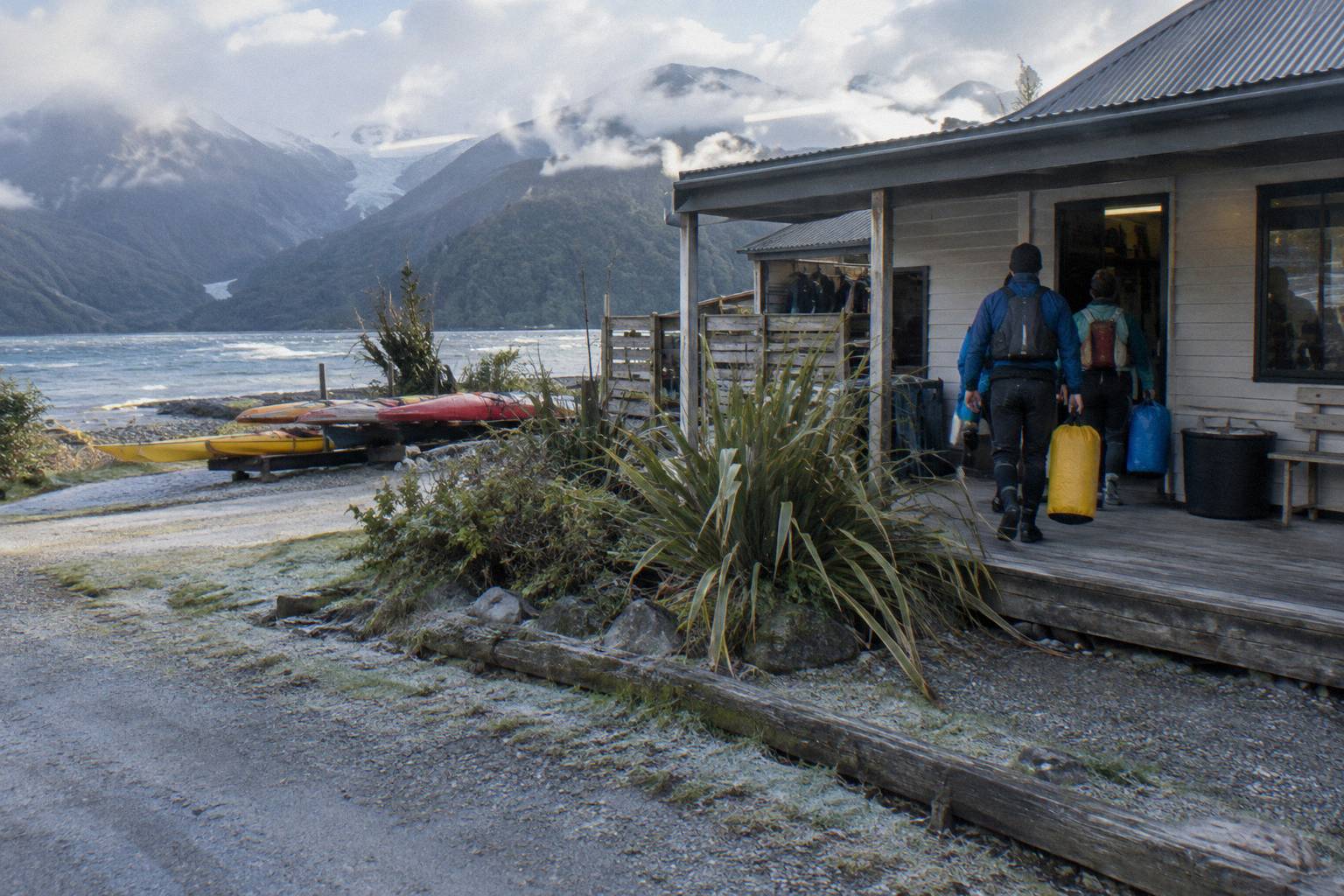
The national lifejacket rule, published by Maritime NZ, applies to everyone on board small craft while underway, with lifejackets still required to be carried for all in every case. Maritime NZ also advises carrying two waterproof ways to call for help and checking the marine forecast, advice aimed mainly at independent paddlers rather than guided groups. On the lagoon, a rescue boat stays on standby during guided trips. If the whole safety question still has you hesitating, the site's piece on nervous paddlers and safety works through it, and for reassurance on the water itself, the Department of Conservation manages the surrounding national park and its visitor information.
What About Children, Feet, Hands And Heads?
Children aged 3 and over are welcome on the three-hour lake trip, with comfortable everyday clothes and the supplied small-sized gear, while Okarito Kayaks guided trips have no minimum or maximum age and take under-18s at half price. Feet stay dry on the lake, so sneakers or sandals work; hands get pogies on the lake and nothing supplied on the lagoon; heads need a cap or beanie by season.
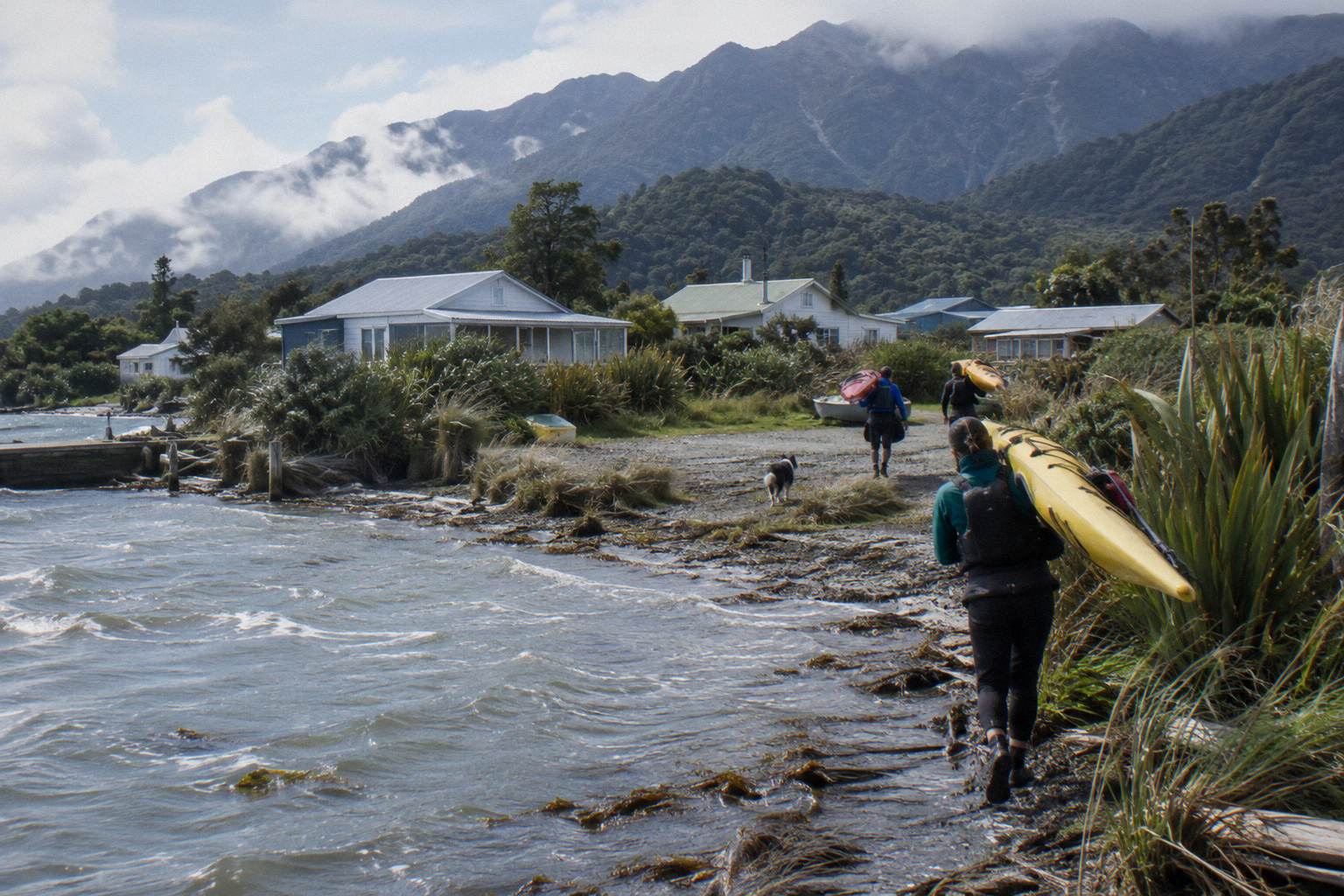
The head-to-toe logic is simple. On the lake, the operator lists cap or sunglasses and nothing else for the head, which in practice means a sun cap in summer and a warm beanie in winter, since you lose heat through your head fastest sitting still. Hands are covered on the lake by the supplied pogies; on the lagoon, nothing is listed, so paddlers who feel the cold bring their own thin gloves. Feet are the anti-climax: the kayaks are sit-in doubles with skirts, and the operator's phrase "feet stay dry" is the whole story, so there is no need for wetsuit boots or river sandals unless you already own and like them.
| Body zone | Summer, 1 Nov to 31 Mar | Winter, 1 Apr to 31 Oct |
|---|---|---|
| Head | Cap or sunglasses, sunscreen applied | Warm beanie under the supplied hood if wet |
| Torso | Light top layer, supplied paddling jacket | Warm fleece or merino layer, supplied jacket over |
| Hands | Pogies supplied on the lake, or bare | Pogies on the lake; own gloves on the lagoon |
| Legs | Quick-dry shorts or trousers, no jeans | Long quick-dry trousers or thermals, no jeans |
| Feet | Sneakers or sandals | Sneakers, plus warm socks for after |
For babies and very young children, the lake operator also runs a shorter discovery-style trip that stays near the shoreline and suits families with infants, and families weighing up the whole question can start with the site's guide to kayak tours for beginners on the West Coast and the practical post on minimum ages for kayak tours near Franz Josef. Dressing children follows the adult logic scaled down: one warm layer more than you would wear yourself, since small bodies cool faster and they sit stiller than the adults doing the paddling.
What Should You Pack In Your Dry Bag?
Pack a camera or phone, a spare warm layer, water and snacks for the lagoon trips, sunscreen and repellent if your trip does not supply them, and any personal medication you would not want separated from you on the water, keeping in mind that the lake operator supplies the dry bag itself and emails free photos taken on the trip.
The supplied dry bag solves the electronics question: phones and cameras travel with the group, not left in a vehicle. On the lake, free photos emailed after the trip mean you can leave the big camera behind entirely if you want to paddle unencumbered. On the lagoon, you carry your own water and snacks, and binoculars if you have them, since birdlife is the headliner there.
| Bring on every trip | Lake Mapourika extras | Okarito Lagoon extras | Leave behind |
|---|---|---|---|
| Warm top layer | Cap or sunglasses | Own rain jacket | Jeans |
| Quick-dry bottoms | Camera or phone (dry bag supplied) | Water and snacks | Towel, wetsuit |
| Comfy sneakers or sandals | Spare warm layer | Binoculars | Changed shoes for after |
| Medication you need nearby | Nothing else required | Sunscreen and footwear | valuables you would mourn |
Two final notes worth keeping. First, all five trips carry free cancellation up to 24 hours before on the booking page, so a doubtful forecast is not a reason to delay booking; the operator's own policy is a full refund with no penalty if you cancel at least 24 hours ahead, and inside 24 hours it is not refundable for any reason. Second, the weather call is never yours to gamble on alone: the operators check local conditions themselves and cancel unsafe days with a full refund, and the site's article on weather cancelling a kayak tour explains how those decisions happen. DOC's Westland Tai Poutini National Park page carries the official regional advice on clothing and sandflies if you want a primary source.
Dress in quick-dry layers, keep the jeans in the bag, trust the supplied gear for the wet stuff, and the rest of the packing list takes care of itself.
Common Questions About What To Wear On A Kayak Tour
Do I Need A Wetsuit For A Kayak Tour Near Franz Josef?
No. Both operators use stable sit-in kayaks with spray skirts, and neither gear list asks for a wetsuit. Dress in quick-drying layers with a warm top instead, and bring your own rain jacket for the Okarito Lagoon trips.
Can I Wear Jeans On A Kayak Tour?
No, the lake operator's rule for bottoms is "anything but jeans". Denim soaks up water, dries slowly and stops insulating when damp, which matters on a cool lake. Quick-dry trousers, leggings or track pants all work.
Will My Feet Get Wet?
Not on the Lake Mapourika trips: the operator states feet stay dry, and comfy sneakers or sandals are the recommended footwear. On the lagoon trips you walk to the water's edge, so wear footwear that can handle a wet launch.
What If It Rains On The Day Of My Tour?
The lake tours run in wet weather and the operator supplies paddling jackets and wet-weather gear, noting light rain can be atmospheric. If conditions are unsafe, the operator cancels and offers an alternative or a full refund. The Okarito trips are tide-timed; check the booking page for their policy.
Do I Need To Know How To Swim?
No. The lake operator's FAQ says you do not need to know how to swim because a correctly fitted life jacket is worn throughout, and lifejackets are now required by law on kayaks nationwide.
What Should Children Wear?
Children aged 3 and over are welcome on the three-hour lake trip and wear the same quick-dry layers, warm top and sneakers as adults, with the operator supplying appropriately sized jackets and PFDs. Okarito Kayaks guided trips have no minimum age and take under-18s at half price.