Do I Need Sandfly Repellent For A Lake Mapourika Kayak Tour?
Sandflies are part of West Coast kayaking. Here is what official sources and the tour listings actually say about repellent, clothing and biting insects around Lake Mapourika.
Yes, bring sandfly repellent. The Department of Conservation warns Westland Tai Poutini National Park visitors that sandflies are prevalent and advises carrying insect repellent, and the booking page for the Lake Mapourika 3-Hour Kayak Tour, from NZ$159 per person, lists insect repellent beside sunscreen in its inclusions. New Zealand sandflies carry no disease, so this is about comfort, yet on a still, cloudy day an unprotected ankle can collect a dozen itchy bites in minutes.
That is the whole answer, but the details matter if you are the kind of person whose ankles swell up. Sandflies on the West Coast of the South Island are a fact of the landscape, not a sign of a badly run tour. The lake sits inside the wet zone: NIWA's 1991 to 2020 records put Franz Josef's mean annual rainfall at 5,555.2 mm, and every single month of the year averages above 300 mm. Insects that breed in wet bush thrive in exactly the country you are travelling to see. The question is not whether sandflies exist here, it is whether they will ruin a paddle, and with a small amount of preparation they very rarely do.
There is a wrinkle worth being precise about, because sloppy advice travels fast in travel forums. Franz Josef Wilderness Tours, the operator on Lake Mapourika, does not mention sandflies anywhere on its own website pages. Its FAQ covers weather, transfers, swimming ability and what to wear, but not biting insects. The sandfly facts come from DOC, from Okarito Kayaks on the lagoon down the road, and from the booking page for the three-hour tour, which lists insect repellent among the inclusions. That is a real, checkable statement, and it is the one to rely on rather than any forum claim about "the operator says".
If you are still choosing which paddle to book, the three most common options from the township are below: the three-hour lake tour with the most reviews, the four-hour combination that adds a rainforest walk in the kiwi sanctuary, and the covered boat cruise for anyone who would rather not paddle at all.
What Are Sandflies, And Why Is The West Coast Their Home?
Sandflies, known to Maori as namu, are small black biting midges about a third the size of a mosquito, and New Zealand has three native species, with the West Coast species the one you meet around Franz Josef. Only the female bites, taking blood to develop her eggs, and because they cannot fly in wind or rain, still, cloudy, humid days on the coast are when you notice them most.
They are slow flyers, which is the single most useful fact about them. Unlike a mosquito, a sandfly takes several seconds to land and settle before it bites, which is why locals say you rarely get bitten if you keep moving. The biting itself is painless at the time; the itch arrives minutes to hours later and can last days on people who react strongly. Reactions vary enormously between individuals, and repeat visitors often report that their reactions fade over successive trips, though that is anecdote rather than settled science.
The reason the West Coast is sandfly country is the same reason it is rainforest. Larvae develop in slow or still water films on damp ground, mud, stream margins and bush litter, and the coast's constant rain supplies that habitat in abundance. Fiordland and Westland are the strongholds. The insects are native, they were here long before people, and the bush around Lake Mapourika is exactly their ideal country: wet, shaded and still.
A note on names, because visitors get confused. What locals call sandflies here are not the sand flies of other parts of the world, and they do not carry disease in New Zealand. The bite is a nuisance, sometimes a strongly itchy one, but nothing worse. That framing matters, because it changes the preparation from a medical question into a comfort question, and comfort questions have cheap, easy answers: repellent, clothing and keeping your arms and ankles covered when the air goes still.
What Do The Official Sources Actually Say?
DOC's guidance for Westland Tai Poutini National Park says to carry warm and waterproof clothing and insect repellent as sandflies are prevalent, and its Lake Matheson walk page, a short drive south of the lake, says plainly that sandflies can be fierce there and to bring insect repellent. Okarito Kayaks, the operator on Okarito Lagoon, mentions sandflies on occasional cloudy, still days and provides an environmentally friendly repellent at its base. These are the sources worth trusting on this topic.
The DOC park advice is the anchor, because it applies to the whole region rather than one beach or one walk. You can read it on the department's Westland Tai Poutini National Park page. It is generic advice for a park that spans glaciers, lakes and coastline, which tells you something: this is a coast-wide insect, not a Lake Mapourika quirk. The same page's clothing advice doubles as kayak advice, since a paddler in a spray skirt is already most of the way to sandfly-proof.
DOC's Lake Matheson page is blunter. "Sandflies can be fierce here. Bring insect repellent." Lake Matheson is about 15 minutes' drive from Franz Josef township, on the same bush fringe as the road to Lake Mapourika, and it is a mirror-reflection walk that many kayak customers visit on the same day. If you are doing both, one bottle serves both, and our longer look at the topic in sandflies and kayaking on the West Coast goes deeper on behaviour and timing.
Down the road at Okarito, the second operator in this region treats sandflies as a routine operational detail. Okarito Kayaks, which runs the Lagoon Explorer and Lagoon Adventurer guided trips, lists environmentally friendly insect repellent among what it provides, alongside dry bags, spray skirts and a rescue boat on standby. Its base at 1 The Strand, Okarito has parking, toilets and hot drinks, and its website notes sandflies on occasional cloudy, still days. You can see the full provided-gear list on the operator's kayak tours page.
Does The Lake Mapourika Tour Itself Provide Repellent?
Yes, in a limited way: the booking page for the Lake Mapourika 3-Hour Kayak Tour lists sunscreen and insect repellent among its inclusions, so you have a backstop if you forget your own bottle. Okarito Kayaks also provides an environmentally friendly repellent on its lagoon trips, but shared bottles stay at the launch or the base, so bring your own.
The three-hour tour is the trip with the most reviews, rated 4.9 from 400+ reviews, from NZ$159 per person. You check in at the Franz Josef Wilderness Tours office on Main Road in the township, at least 15 minutes early, and a courtesy transfer takes you to the lake about ten minutes north on SH6. The operator says around 2 hours 25 minutes of that three hours is actual kayaking, in stable double kayaks, crossing the lake into a hidden mirror creek inside the predator-free Okarito Kiwi Sanctuary. Groups usually run 2 to 6 people, with the booking page showing up to 16.
What the operator lists as provided is substantial: dry bag, paddling jacket, PFD, wet-weather gear, kayak skirt, pogies, paddle, and photos emailed free afterwards. The booking page adds sunscreen and insect repellent to that list. Bring, per the operator: cap or sunglasses, camera or phone, comfy sneakers or sandals because your feet stay dry, a warm top layer, and bottoms of anything but jeans. If you want the fuller argument on that last point, our piece on why jeans fail on a kayak tour covers it.
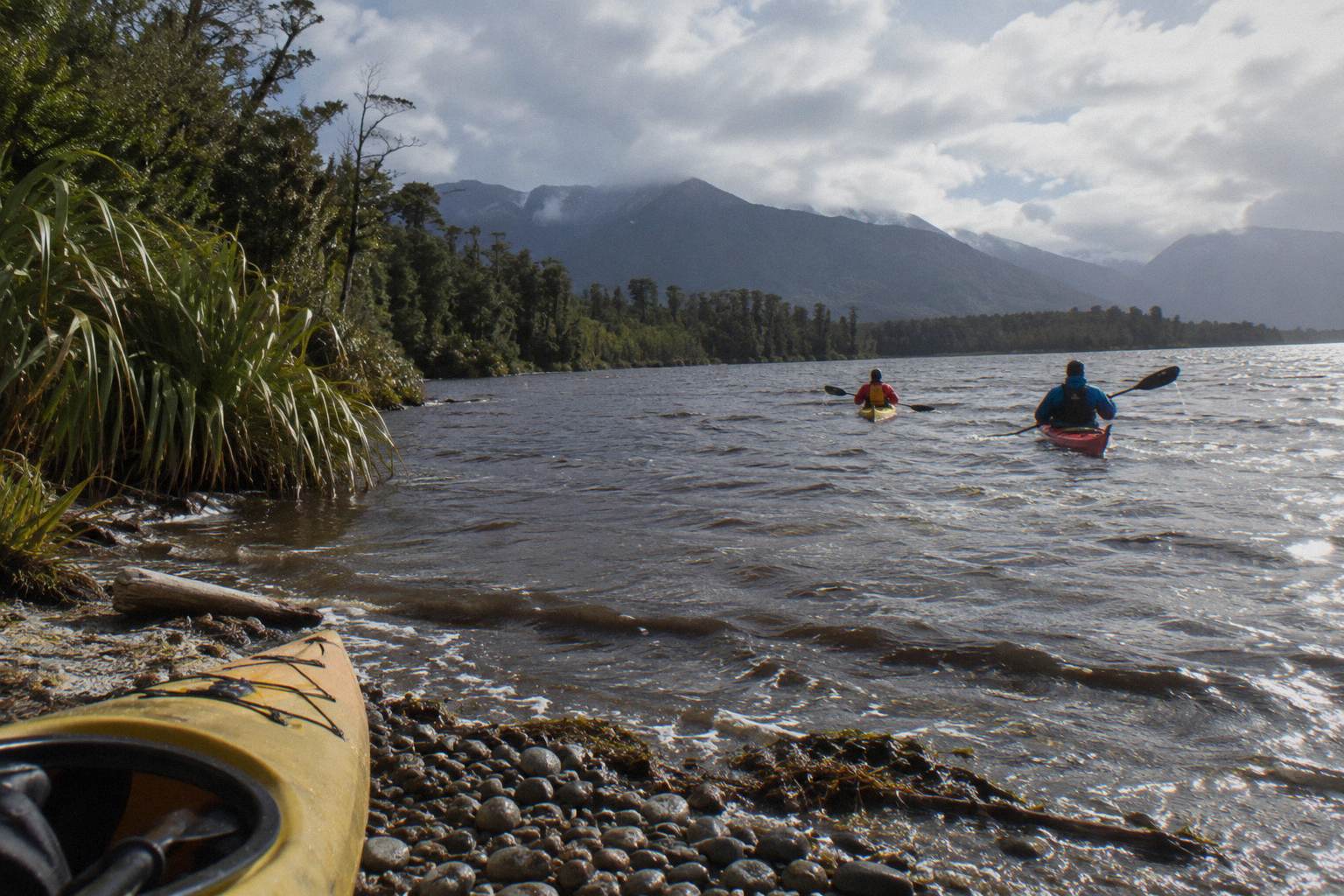
One caveat about the mirror creek, which is the scenic heart of the trip. Still, sheltered, tree-lined water is precisely where sandflies are most comfortable, so the best wildlife moment of the tour is also the moment your own repellent matters most. A communal bottle at the launch does not help you forty minutes into a creek with no wind. Pocket the spray before you leave the shore, and reapply after the halfway stop if you are a magnet for bites.
Which Repellent Actually Works On Sandflies?
DEET at 30 to 40 percent, picaridin at around 20 percent, or oil of lemon eucalyptus at the higher labelled concentrations all work on New Zealand sandflies, and any of them beats nothing by a wide margin. What matters more than the active ingredient is coverage: ankles, wrists, the back of your neck and any gap between sleeve and glove. Locally sold bush-strength sprays are formulated for exactly these insects, and the West Coast's shops all stock them.
New Zealand sandflies have no special resistance; they are ordinary biting midges and standard repellents do the job. The practical hierarchy is about convenience on the water. A spray you can apply one-handed to your own ankles while sitting in a double kayak is worth more than a stronger cream in a tube at the bottom of a dry bag. Aerosols struggle in wind, roll-ons are slow, pump sprays are the middle path, and lotion lasts longest per application. Whichever you choose, a small bottle in a jacket pocket beats a large one in the car.
| Repellent type | Typical strength | How it behaves on a paddle | Best use |
|---|---|---|---|
| DEET spray | 30-40 percent | Effective, can sting cuts, damages some plastics | All-round choice, reapply after the halfway stop |
| Picaridin spray | around 20 percent | Lighter feel, less odour, gear-friendly | Everyday paddle, sensitive skin |
| Oil of lemon eucalyptus | as labelled | Plant-derived, shorter effective window | Short trips, reapply often |
| Smoke or citronella | n/a | Weak in open air, useless while paddling | Camp evenings only |
Two West Coast-specific notes. First, the region's shops, including the Franz Josef township stores, carry local and imported repellents year round, so forgetting a bottle is fixable for the price of a coffee. Second, if you are heading to Okarito for a lagoon trip as well, Okarito Kayaks hands out an environmentally friendly repellent at the base, which suits travellers who prefer the plant-based end of the shelf or who simply ran out. Treat that as a supplement, not a plan: departures there are tide-timed and self-arrival, so there is no window to pop back to a shop.
Timing interacts with repellent more than most visitors expect. Because sandflies cannot fly in breeze or rain, a windy or showery paddle can need no repellent at all, while the classic still evening, the exact condition that produces the lake's famous mirror reflections, is peak sandfly weather. Regulars plan for both: repellent applied at the shore regardless, because the forecast cannot tell you what the air is doing inside a sheltered creek.
What Else Helps: Clothing, Movement And A Bit Of Cynicism
Covering skin beats treating it, and on a kayak you are already most of the way there: spray skirt over the legs, pogies over the hands, paddling jacket over the arms, so the exposed zones are the face, neck and a strip of ankle. Long socks under sandals close the ankle gap entirely. Sandflies are slow, so simply keeping the kayak moving frustrates them, and they bite least in wind, rain or bright sun.
The operator's own clothing list does double duty here. A warm top layer and a paddling jacket are about comfort, but they are also sandfly armour, and the wet-weather gear provided on the three-hour tour covers you completely on drizzly days, which happen to be low-bite days anyway. Feet stay dry on this trip, so a pair of long socks with sneakers or sandals is the cheapest sandfly upgrade available. Our broader guide on what to wear on a kayak tour works through the full layering system.
Behaviour matters more than people expect. A sandfly needs to land and settle before biting, and it cannot keep up with a paddling kayak, so a group on the move is largely untouchable. Bites cluster around the launch, the shoreline briefing and the still-water photo stops. That is when the pocket bottle earns its place. If you react badly to bites, an antihistamine tablet taken before the trip and a bite cream in the dry bag are the standard additions; a pharmacist in Franz Josef township can sort both in one stop.
The cynical local trick is simply to stand next to someone more attractive to the insects, but the plain version of that advice is that carbon dioxide output draws them, so a person recovering from a strenuous morning hike gets more attention than a relaxed one. On the combined kayak and sanctuary walk trip, the four-hour option from NZ$179 per person rated 4.9 from 120+ reviews, the hour spent on foot through the rainforest track is the likeliest bite window of the day, since it adds a walking pace, a sheltered canopy and sweat all at once.
What Should Actually Go In Your Day Pack?
For the three-hour Lake Mapourika tour: your own repellent in a jacket pocket, sunscreen, a warm top layer, a cap or sunglasses, camera or phone, comfortable footwear you do not mind getting damp, bottoms that are not jeans, and any personal bite cream or antihistamine you normally use. The operator supplies the paddling wardrobe, the dry bag and the kayak hardware, and the booking page adds sunscreen and insect repellent, so everything you carry is small and personal.
The packing divide is simple: big items are provided, small personal items are yours. Dry bag, paddling jacket, PFD, wet-weather gear, kayak skirt, pogies and paddle come with the tour. Photos are emailed free afterwards, so you do not even need to fight a phone out of a pocket on the water, though almost everyone does at the creek. The table below is the whole decision in one view.
| Item | Provided on the tour | Bring your own | Notes |
|---|---|---|---|
| Insect repellent | Listed on the booking page | Yes, pocket size | Own bottle reaches the creek with you |
| Sunscreen | Listed on the booking page | Yes, small | Reflected glare off the water is real |
| Paddling jacket, wet-weather gear | Yes | No | Also sandfly cover for arms |
| Footwear | No | Sneakers or sandals | Feet stay dry; add long socks for ankles |
| Warm top layer | No | Yes | West Coast weather turns fast |
| Dry bag, PFD, skirt, pogies, paddle | Yes | No | Standard kit on every departure |
| Bite cream or antihistamine | No | If you react badly | Pharmacies in the township stock both |
Two regional habits are worth copying from people who live here. First, keep the repellent where you can reach it while seated in the kayak, not zipped into a bag the guide is carrying. Second, reapply at any stop longer than a few minutes, because sweat and paddling spray thin every repellent faster than a walk in the park would. Neither habit costs anything and both are the difference between an anecdote about a beautiful creek and an anecdote about itching.
A last note for anyone extending the trip toward Okarito. The lagoon trips run from a different operator's base, are tide-timed, and need a minimum of two adults booked to confirm a departure, and the booking pages exclude anyone over 200 cm or over 125 kg. Repellent there is provided and environmentally friendly, but the drive out, about 25 minutes north of Franz Josef, passes through prime sandfly bush, so keep the bottle accessible in the car rather than buried in luggage. Our overview of kayaking Okarito Lagoon covers that water in full.
Common Questions About Sandfly Repellent On A Lake Mapourika Kayak Tour
Do I Need Sandfly Repellent For A Lake Mapourika Kayak Tour?
Yes, bring your own even though the booking page lists insect repellent among the tour's inclusions. DOC says sandflies are prevalent across the region, still and cloudy days are when they bite, and a personal bottle in your jacket pocket is with you at the sheltered creek where communal supplies are not.
Are Sandflies Dangerous?
No. New Zealand sandflies do not transmit disease. The bite is painless at first and then itches, sometimes for days on people who react strongly. Antihistamines and bite cream manage the reaction, and pharmacies in Franz Josef township stock both.
When Are Sandflies Worst?
On still, cloudy, humid days, at launch points and shoreline stops, and wherever sheltered water or bush blocks the breeze. They cannot fly in wind or rain, so breezy and showery paddles often involve almost none. No month is reliably sandfly free on the West Coast.
Does The Tour Provide Repellent?
The booking page for the Lake Mapourika 3-Hour Kayak Tour lists insect repellent and sunscreen among its inclusions. Okarito Kayaks provides an environmentally friendly repellent at its base for lagoon trips. Bring your own regardless, because shared supplies stay at the launch.
What Clothing Stops Sandfly Bites?
Long socks under sneakers or sandals close the ankle gap, and the paddling jacket, spray skirt and pogies supplied on the tour cover everything else. Sandflies are slow flyers, so a moving kayak is nearly bite proof; bites happen when you are standing still at the shore.
Does Repellent Wash Off While Paddling?
Sweat and spray thin it faster than dry-land use, so reapply at any stop longer than a few minutes. A pocket-size bottle you can reach while seated works better than a large one stored in the dry bag the guide carries.
Planning a West Coast paddle is mostly about layers and small bottles, and Franz Josef Kayak Tours exists to make those calls easy. Repellent is the smallest item on the list and the one you will be gladdest to have when the air goes still on the mirror creek. The three trips below cover the usual ways to get on this water: the three-hour tour with the most reviews, the four-hour kayak and sanctuary walk, and the covered cruise that skips the paddle altogether.