Kayak Tours In The Rain Near Franz Josef: What To Expect
Franz Josef records a mean of 5,555.2 mm of rain a year, so a wet forecast is closer to the rule than the exception. Kayak tours here are built for it: the lake operator supplies jackets and wet-weather gear and says light rain can be atmospheric, and cancellation with a full refund only happens when conditions are unsafe.
Short answer
Yes, kayak tours near Franz Josef run in the rain. Franz Josef Wilderness Tours supplies paddling jackets, PFDs and wet-weather gear and only cancels when conditions are unsafe, with a full refund. Its 3-Hour Lake Mapourika Kayak Tour costs from NZ$159 per person. You can cancel yourself up to 24 hours before for a full refund.
Rain is the default setting on this coast, not an anomaly. NIWA records put Franz Josef's mean annual rainfall at 5,555.2 mm, and every single month of the year averages above 300 mm. A visitor who cancels a paddle the moment the forecast turns grey is, statistically, cancelling most of the calendar. The good news is that the local operators plan around exactly this, and a wet day on the water is a normal, workable day here rather than a write-off.
Here is what actually happens when it rains: whether tours run, what gear you get handed at the lake, what the cancellation rules say, and how to dress so the day stays comfortable. The picture draws on the operators' own published policies, NIWA climate records and Department of Conservation guidance, and it comes down to two kayak operators: Franz Josef Wilderness Tours on Lake Mapourika, and Okarito Kayaks on Okarito Lagoon.
Do Kayak Tours Near Franz Josef Run When It Rains?
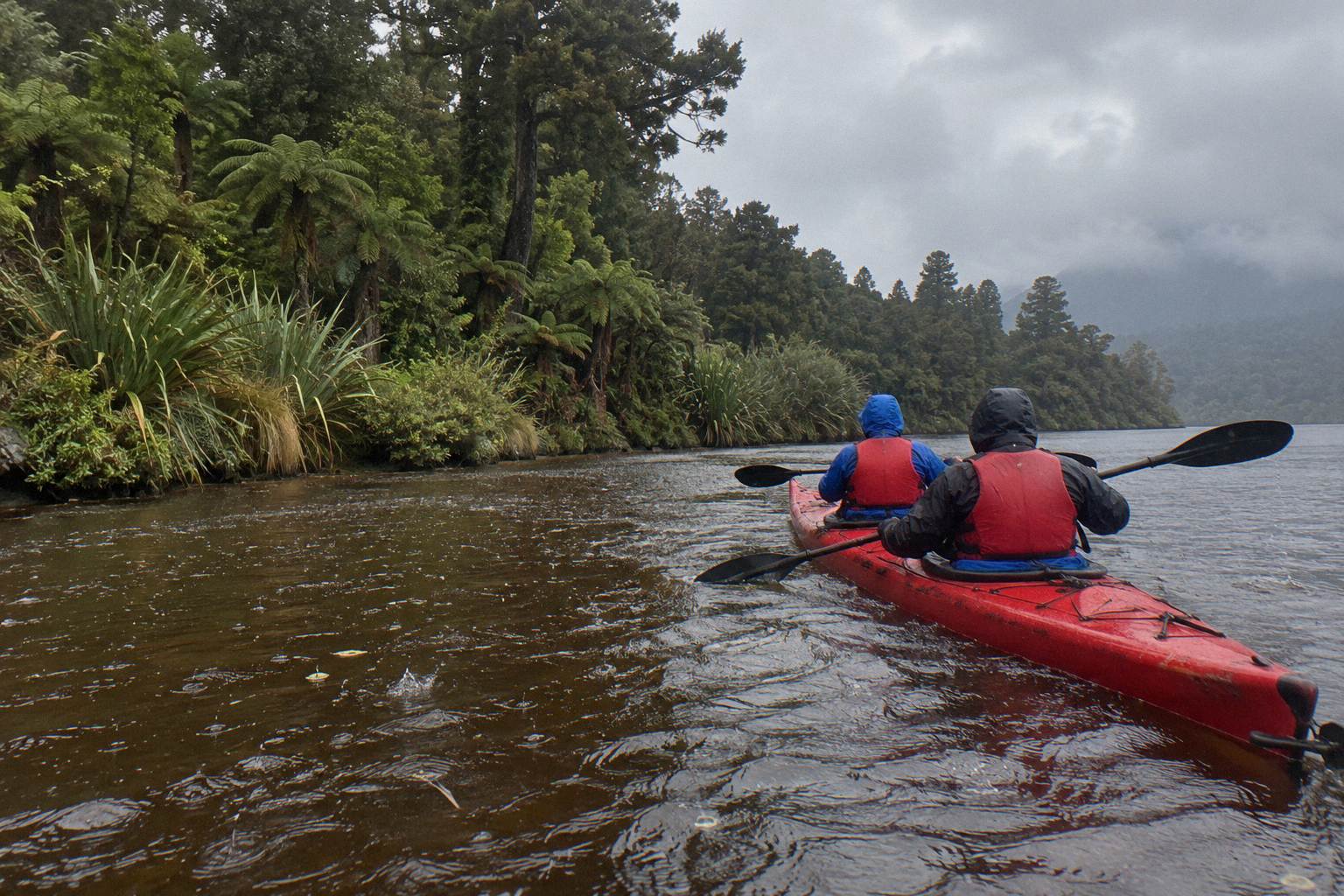
Yes. Franz Josef Wilderness Tours runs its lake trips in wet weather, supplies paddling jackets, PFDs and wet-weather gear, and states plainly that kayaking can be especially atmospheric in light rain. The company cancels only when conditions are considered unsafe, and then offers an alternative or a full refund. The two Okarito Lagoon trips are tide-timed guided paddles.
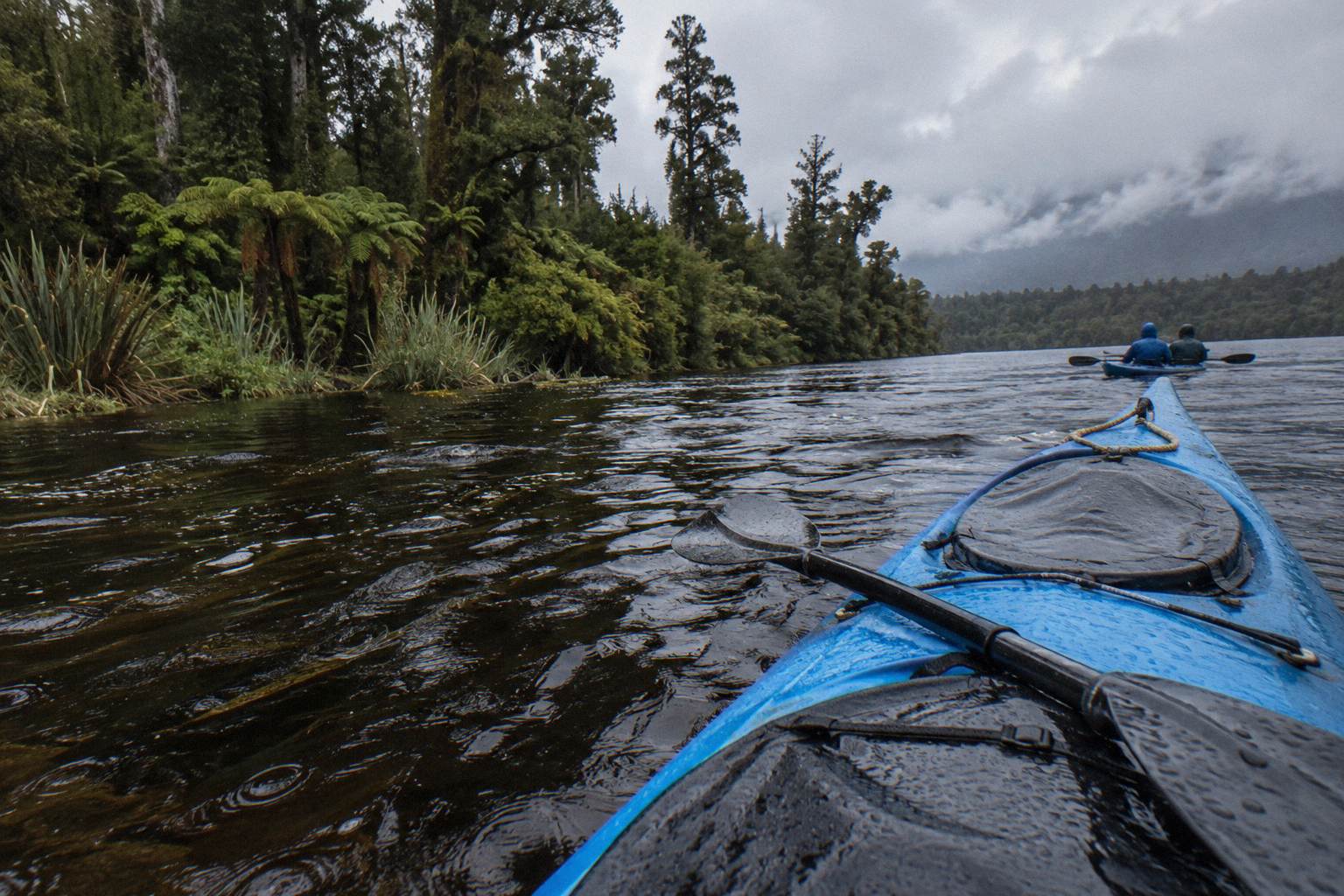
The lake operator's own words on the question are the clearest summary available: "Kayaking can be especially atmospheric in light rain." That is not a shrug of tolerance, it is a position. Westland rainforest exists because of this weather, and paddling into it under low cloud is a different experience from a blue-sky postcard, not a lesser one. The company supplies a paddling jacket, a PFD, wet-weather gear, a kayak skirt and pogies (the neoprene mitts that keep hands warm on the paddle) on its signature lake trip, which means the rain does not have to reach your skin at all.
There is also a local-knowledge point worth knowing before you cancel from your hotel room. The operator checks conditions itself and notes that "often times it's dry at Lake Mapourika while it's raining in the township." The lake sits about a ten-minute drive north on SH6 from Franz Josef, and the township's weather and the lake's weather are not the same thing. The company recommends checking the Windy forecast app for a read on the specific spot rather than trusting a generic township forecast.
For Okarito Lagoon, the answer is different in one respect. Okarito Kayaks runs small-group guided trips timed around the tides. A rescue boat stands by, and buoyancy aids, spray skirts and dry bags are provided, which is a wet-weather-capable kit list.
How Much Does It Actually Rain In Franz Josef?
NIWA records for 1991 to 2020 give Franz Josef a mean annual rainfall of 5,555.2 mm, with every month above 300 mm. The wettest months are October at 594.1 mm, December at 593.7 mm and January at 552.0 mm; the driest are July at 317.8 mm and February at 357.6 mm. There is no dry season here, only degrees of wet.
Those numbers deserve a moment of reflection, because they reframe the whole decision. Even the driest month of the year averages more rain than many European cities see in their wettest. Yet the tours run year round, summer sessions from 1 November to 31 March and winter sessions from 1 April to 31 October, with differing departure times. Rain is a design constraint the operators have already solved for, not a reason the industry shuts down for a season.
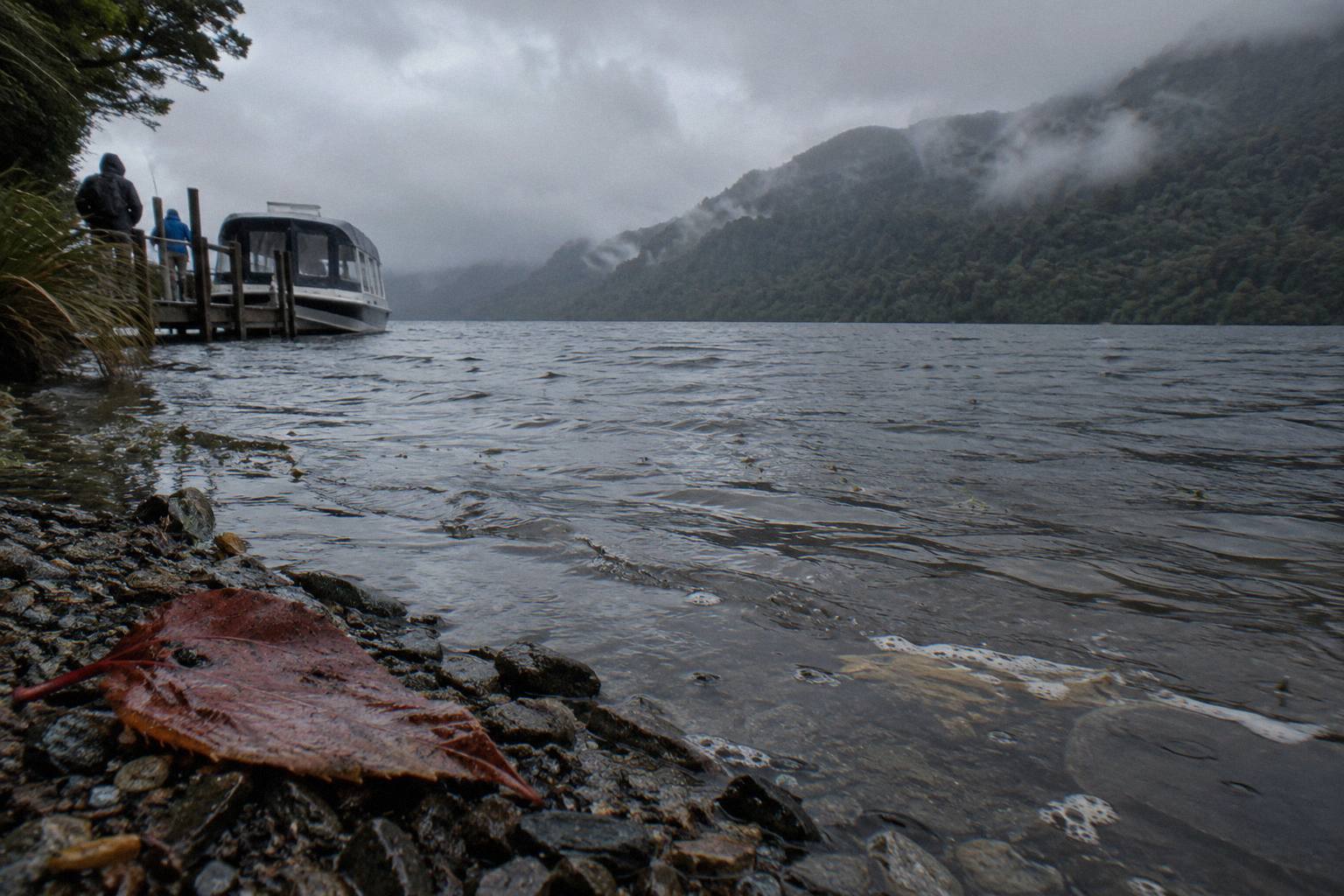
Temperature matters as much as rainfall for comfort. Mean daily maxima run from 20.0 degrees in January to 11.9 degrees in July, and mean daily minima from 10.5 degrees in January down to 3.3 degrees in July. In other words: summer rain is a warm rain, winter rain is a cold rain, and what you wear under the supplied gear matters more in July than in January. Sunshine totals about 1,169 hours a year, with January averaging 118 hours and December 83, so bright spells exist and are worth chasing.
| Month | Mean rainfall (mm) | What it means for a paddle |
|---|---|---|
| October | 594.1 | Wettest month on record; pack for rain as the base case |
| December | 593.7 | Close behind; warm though, with long daylight |
| January | 552.0 | Peak summer and peak rain together |
| February | 357.6 | One of the two driest months |
| July | 317.8 | Driest month, but cold: mean minimum 3.3 °C |
Only those months are stated in the NIWA-derived figures; other months exist in the record but are not quoted here, and inventing a "dry season" would be false. If you want to weigh the calendar further, our guide to the best time of year for a West Coast paddle works through the seasons in more detail.
The practical takeaway is simple: book the trip you want, on the day you want, and treat rain as likely rather than as a dealbreaker. If the money question is the one holding you back, see what a kayak tour near Franz Josef costs, where the from-prices for all five trips are laid out side by side.
What Gear Do Operators Hand You When It Rains?
On the Lake Mapourika trips, Franz Josef Wilderness Tours supplies a dry bag, paddling jacket, PFD, wet-weather gear, kayak skirt, pogies and paddle, and emails free photos afterward. Okarito Kayaks provides a buoyancy aid, spray skirt, dry bags, a lagoon map and bird guide, environmentally friendly insect repellent, and keeps a rescue boat on standby. Neither kit list leaves you buying rain gear to participate.
The lake kit list is unusually complete. The kayak skirt seals you into the cockpit so rain and spray stay outside the boat, the pogies cover the one part of you that must be exposed, your hands, and the wet-weather gear goes over your own clothes. The operator's advice on footwear is reassuring for anyone worried about cold feet: comfy sneakers or sandals are fine because feet stay dry. That is a function of the stable double kayaks used on the lake trips, which keep you low, seated and out of the water rather than balancing over it.
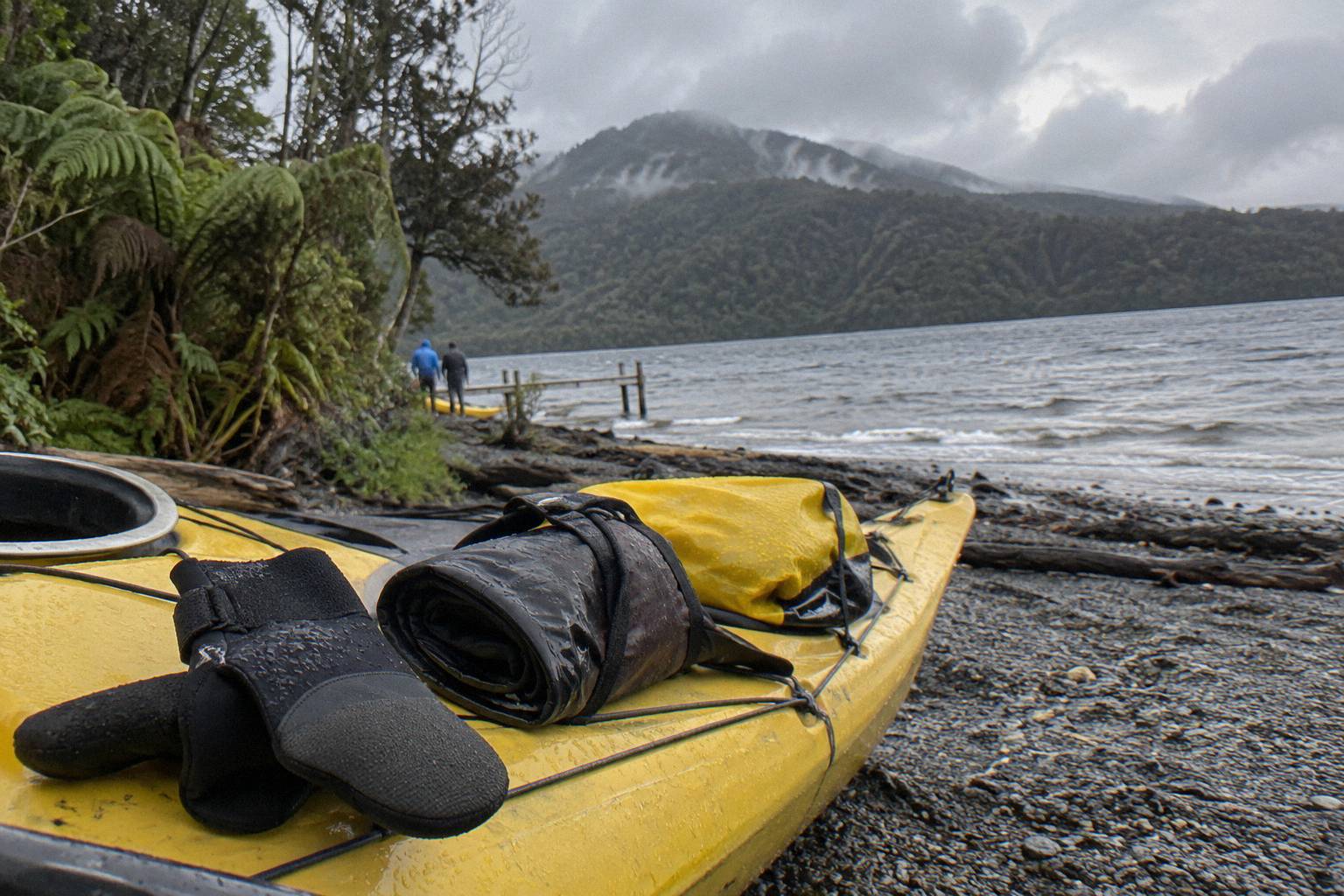
The operator's FAQ also settles the two questions nervous first-timers ask most. Previous experience is not needed. And, in the operator's words, "You do not need to know how to swim, as a correctly fitted life jacket is worn throughout." That last point is now also the law nationwide: since 9 October 2026, everyone on a recreational craft 6 metres or under, kayaks included, must wear a lifejacket while underway, per Maritime NZ's lifejacket rules.
At Okarito the kit leans toward the birdlife: the map and bird guide matter because the lagoon is a feeding ground for kotuku, the white heron, year round. The base at 1 The Strand has parking, toilets and hot drinks, which is a meaningful detail on a cold wet morning since you arrive 10 to 15 minutes before start and self-arrive, with no transfer listed.
| Supplied in wet weather | Lake Mapourika trips | Okarito Lagoon trips |
|---|---|---|
| Flotation | PFD worn throughout | Buoyancy aid |
| Rain protection | Paddling jacket and wet-weather gear | Spray skirt; bring your own rain jacket |
| Hands | Pogies | Check when booking |
| Storage | Dry bag | Dry bags |
| Extras | Free emailed photos | Bird guide, insect repellent, rescue boat on standby |
Note that Okarito Kayaks asks you to bring your own rain jacket.
The featured lake trip, the 3-hour Lake Mapourika paddle with the most reviews, from NZ$159 per person with a 4.9 rating from 400+ reviews, is a good example of the logic: you check in at the Main Road office in Franz Josef township, get kitted out, and take the courtesy transfer to the lake, so the rainiest part of the day, standing around before launch, happens indoors or in a vehicle.
What Should You Wear Kayaking In The Rain?
The operator's own list for the lake trips: a cap or sunglasses, camera or phone, comfy sneakers or sandals (feet stay dry), a warm top layer, and bottoms of anything but jeans. Okarito Kayaks asks for warm quick-drying clothing, a rain jacket, footwear, water, snacks, sunscreen and a camera. The single most important rule on both lists is the same: never denim, because wet jeans stay wet and cold for hours.
Jeans deserve their own sentence because they are the one genuinely bad choice. Cotton denim absorbs water, holds it against your skin, and loses all insulating value, which on a 12-degree July drizzle afternoon turns a pleasant paddle into a shivering one. Synthetic leggings, fleece, merino or running tights all behave properly: they shed drizzle, and where they do wet out they still trap warmth. Our fuller treatment of this, including layering by season, is in what to wear on a Franz Josef kayak tour.
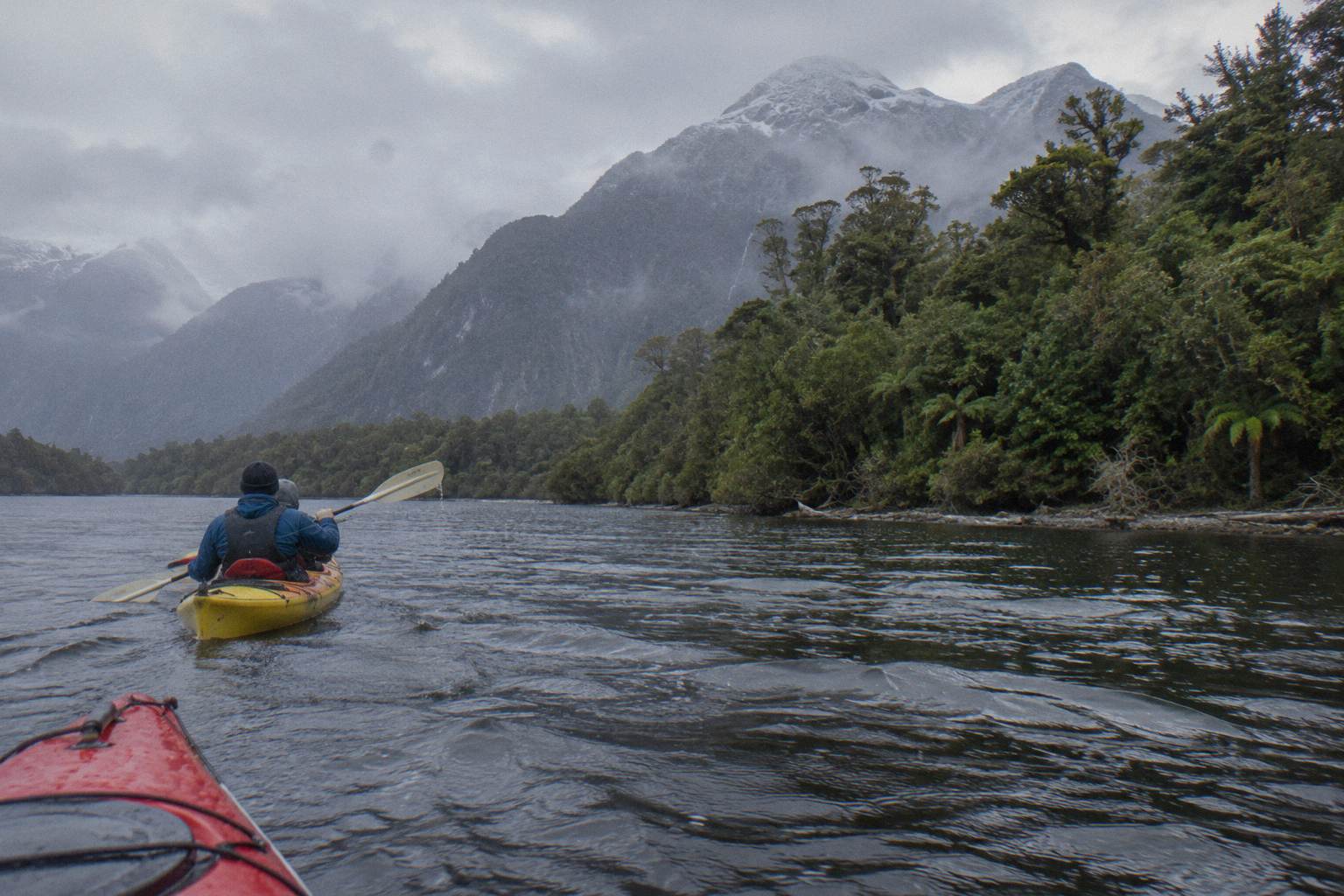
The warm top layer matters more than the rain layer, oddly enough, because the operator supplies the rain layer. What the operator cannot supply is the insulation under it. In summer a single fleece is plenty; in winter, with a mean daily minimum of 3.3 degrees in July, two warm layers under the supplied jacket is the sensible call. A cap keeps drizzle off your glasses and warmth in your head, which is where a surprising amount of body heat leaves from.
Footwear is the anti-worry item. Because the lake trips use stable double kayaks and the operator says feet stay dry, you do not need wetsuit boots or a sacrificial pair of trainers. Wear the shoes you planned to walk around Franz Josef in. At Okarito, follow the operator's general footwear guidance and expect to step out at a tidal ramp where the last stride can be splashy.
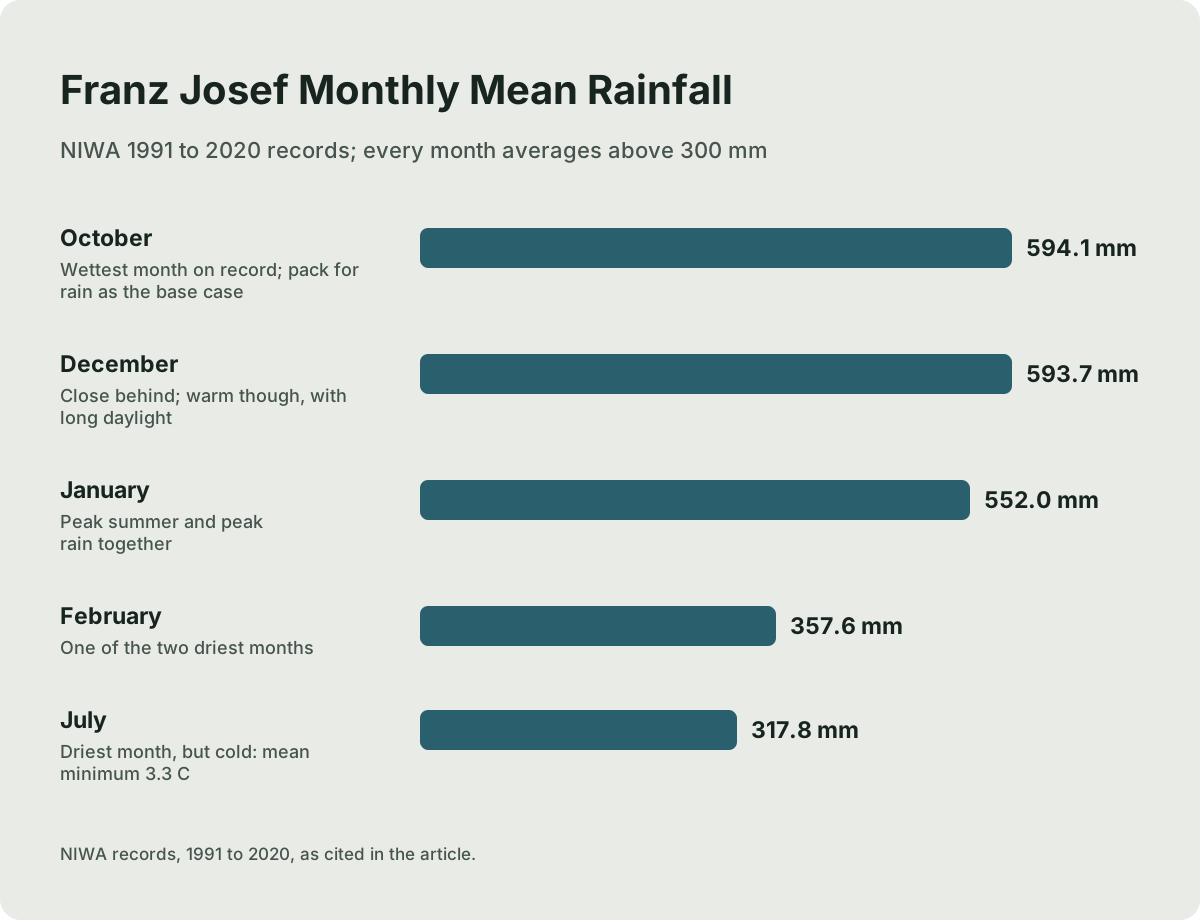
The infographic above shows the shape of the decision: there is no month where rain is unlikely, only months where it is slightly less likely. Dress for the chart, not for the forecast.
When Does Rain Actually Cancel A Tour?
Franz Josef Wilderness Tours cancels only when conditions are considered unsafe, and then offers an alternative or a full refund. On your side, changing or cancelling at least 24 hours before the departure earns a full refund with no penalty; inside 24 hours the booking is not refundable for any reason, and private or group bookings carry a 48-hour rule. The operator can also cancel for minimum numbers or unsafe conditions, always with a full refund.
This is the part of the contract to read carefully, because it cuts both ways. The operator takes the weather risk: if the lake is genuinely unsafe, you get your money back or a reschedule, and you do not have to argue about it. You take the commitment risk: once you are inside 24 hours, a rainy-but-safe day will run, and backing out then forfeits the payment. A "rainy but safe" day is, by the operator's own framing, most rainy days. Everything else covered here is indexed on Franz Josef Kayak Tours.
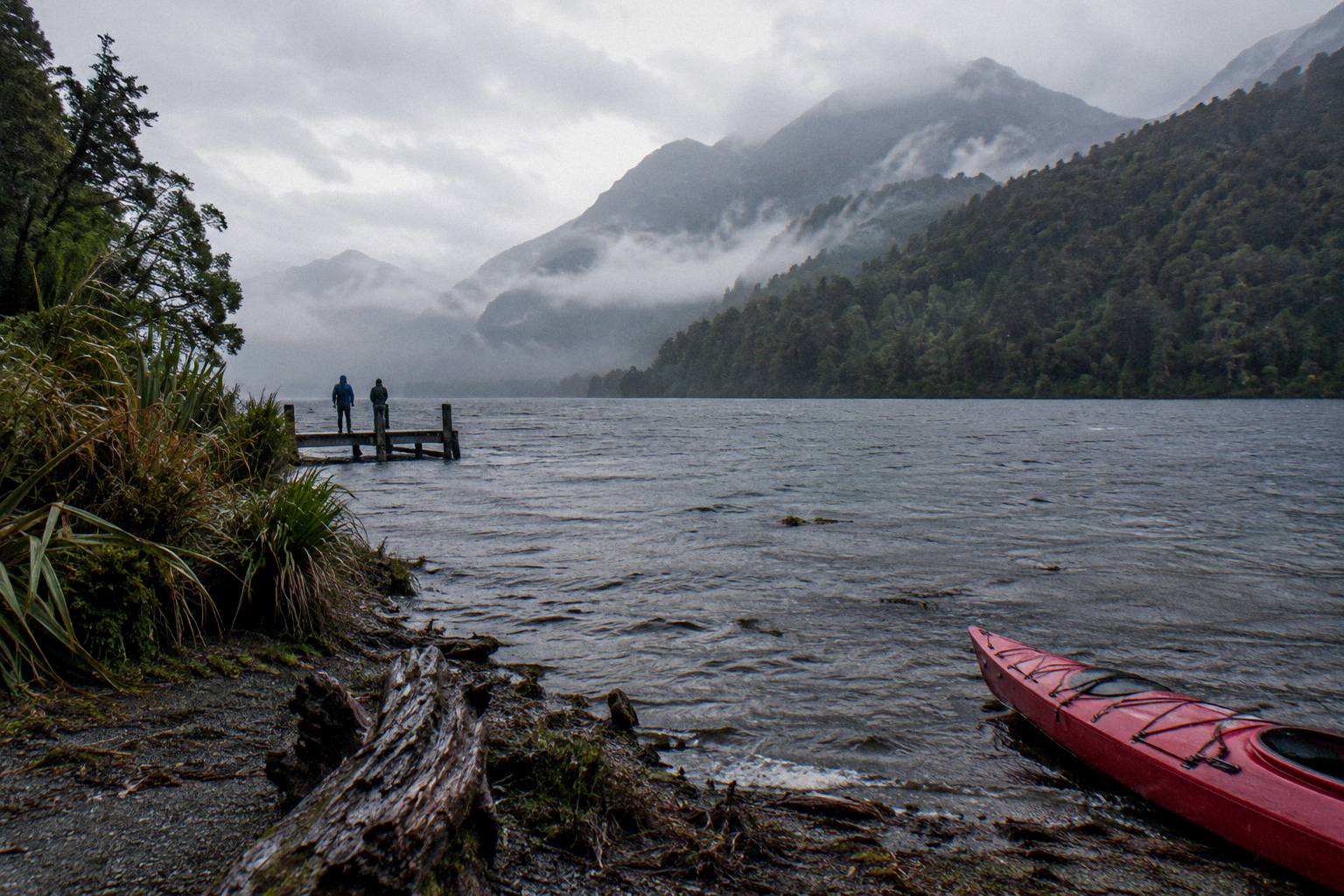
What counts as unsafe is the operator's call, and it is a professional one. The company checks local conditions itself rather than following a blanket township forecast, which is why its note that the lake is often dry while the township rains matters: cancellations track the water, not the main street. Wind matters more than rain on a lake, since an exposed stretch of open water under strong wind is the genuine hazard; the rain itself almost never is. The operator's risk disclosure is candid that the lake is deep and exposed and that assistance can be one to two hours away, which is exactly why the PFD is non-negotiable and why the unsafe-conditions clause exists.
The booking-page terms for all five trips show free cancellation up to 24 hours before. For the two Okarito trips, remember two things from the operator's own rules: departures need a minimum of two adults booked to confirm, and start times are scheduled around the best tidal conditions for the day, so your "rain question" there is really a tide question first and a weather question second. Our piece on how Okarito Lagoon tides shape kayak timing explains that interplay.
| Situation | Who acts | Outcome |
|---|---|---|
| Unsafe conditions on the day | Operator cancels | Alternative or full refund |
| Minimum numbers not met | Operator cancels | Full refund |
| You cancel 24+ hours ahead | You | Full refund, no penalty |
| You cancel inside 24 hours | You | Not refundable |
| Private or group booking | You | 48-hour rule applies |
One practical habit follows from all this: book early in your stay, not on your last day. If the operator does cancel for safety, an early booking leaves you days to reschedule, while a final-day booking leaves you nothing.
If rain looks likely and you want the most weather-sheltered water time per dollar, the Lake Mapourika Kayak And Okarito Kiwi Sanctuary Walk, from NZ$179 per person and rated 4.9 from 120+ reviews, splits its 4 hours between roughly 2 hours 15 minutes of paddling and about an hour on a private rainforest track, which means a wet stretch of the day happens under canopy rather than on open water.
Is Kayaking In The Rain Actually Good?
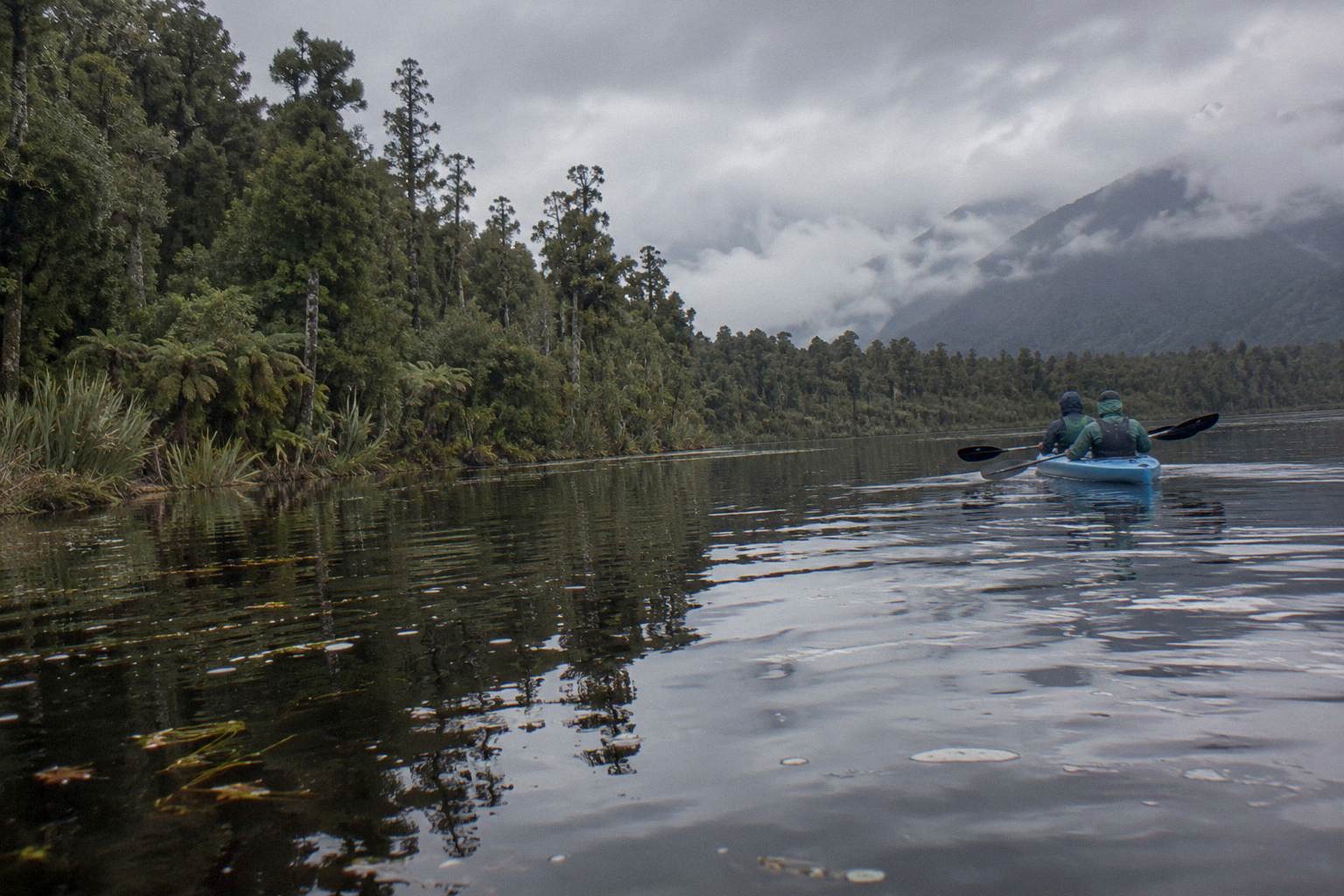
Often, yes. The operator says mirror-lake reflections are often really dramatic when it is cloudy, and light rain is described as atmospheric. Rain also brings out the rainforest: mist in the tree line and a soft grey lake are the classic Westland look. What rain does not bring is guaranteed glacier views, which the operator says appear only on clear days when the clouds are not sitting low in the valley.
The reflection point is the genuinely useful insight here, and it runs against most visitors' instincts. DOC's guidance at nearby Lake Matheson says the best reflections come on sunny, windless days at dawn and dusk, and that is true as far as it goes. But the lake operator adds a second, less obvious truth from its own guides' experience: cloud sitting on the water can make the tannin-dark surface look like poured glass, with the forest doubled below it. Overcast light is flat and even, which is precisely what a mirror needs. Bright sun, by contrast, puts glare on the water.
Glacier views are the counterweight. The lake is not at the glacier, and the operator is explicit that on clear days many glaciers are visible, including the neve of the Franz Josef Glacier, while lower cloud removes them. If seeing glacier ice from the water is your main goal, rain works against you. If reflections, forest and quiet are your goal, rain can work for you. Photographers can take the point further in how to photograph mirror reflections from a kayak.
Wildlife does not mind the rain. The rowi kiwi sanctuary fringing the lake covers around 11,000 hectares by the operator's account, and kotuku feed throughout Okarito Lagoon year round, with DOC noting they feed there in the September-to-February breeding season. Wet, still days are often when the lagoon is at its most bird-full, since wind, not rain, is what pushes birds into cover.
A final perspective check: DOC's own park guidance for Westland Tai Poutini National Park tells visitors to carry warm and waterproof clothing and insect repellent because sandflies are prevalent. In other words, the entire visitor economy of this coast, from day walks to multi-day tramps, is built around going out in weather that would cancel a picnic almost anywhere else. Kayaking in the rain here is not a hardship, it is the median experience.
Rain On Two Different Waters: Lake Or Lagoon?
Lake Mapourika is a kettle lake, about 9 square kilometres by the operator's description, roughly ten minutes' drive north of Franz Josef, with a courtesy transfer from the township office. Okarito Lagoon is a shallow tidal lagoon about 25 minutes north, self-arrival at the operator's base on The Strand, with trips timed to tides. Rain behaves differently on each: the lake is about wind, the lagoon is about tide and shelter.
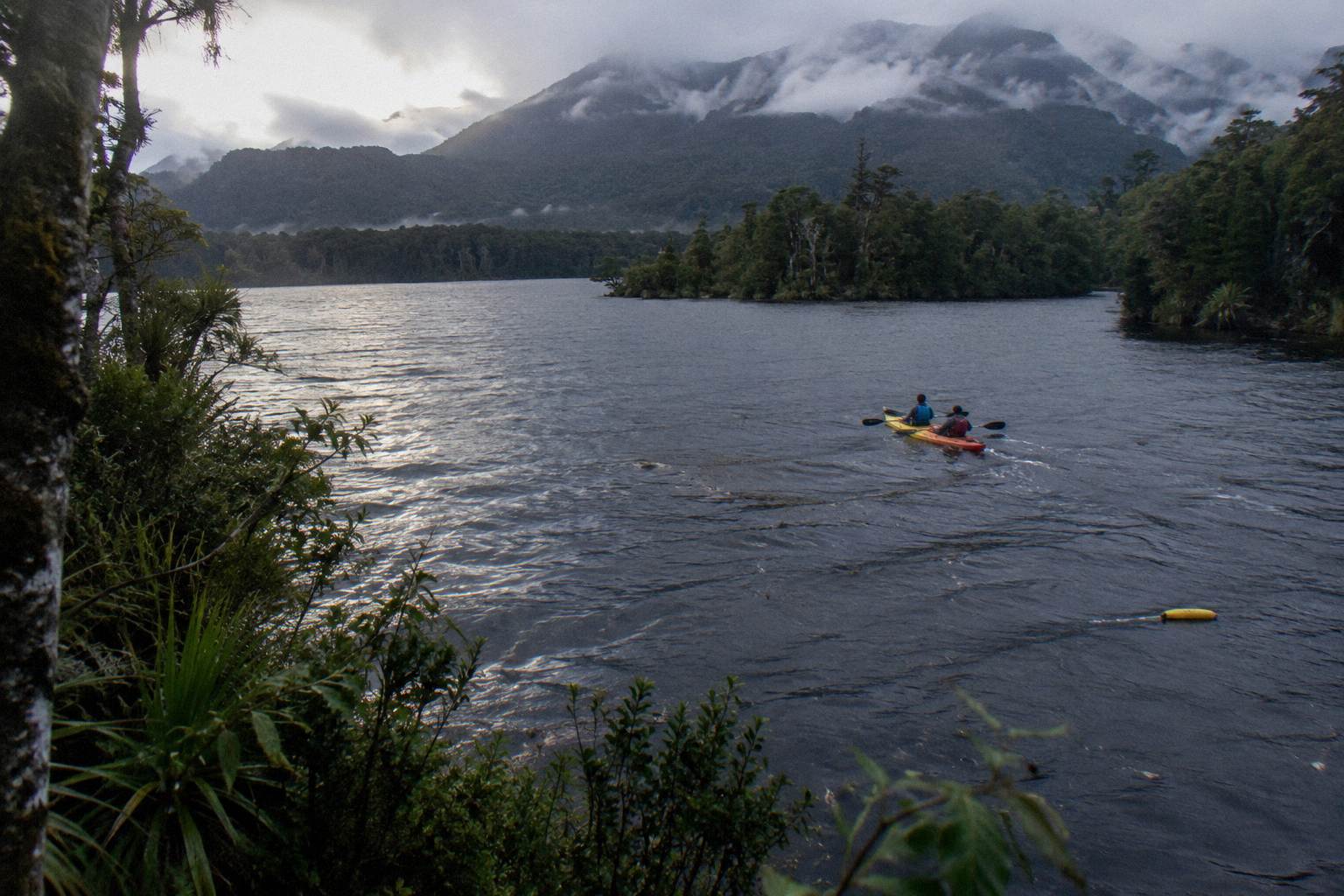
The choice between them on a wet forecast comes down to what kind of wet day it is. On a drizzly, calm day, both waters work: the lake gives you the mirror creek and the sanctuary fringe, the lagoon gives you channels between forested islets and the best kotuku viewing. On a windy wet day, the sheltered creek sections of the lake trip have an edge, since the route crosses open water but spends its payoff in protected inlets. The operator's stable double kayaks also lower the difficulty floor for anyone whose confidence sags with the barometer.
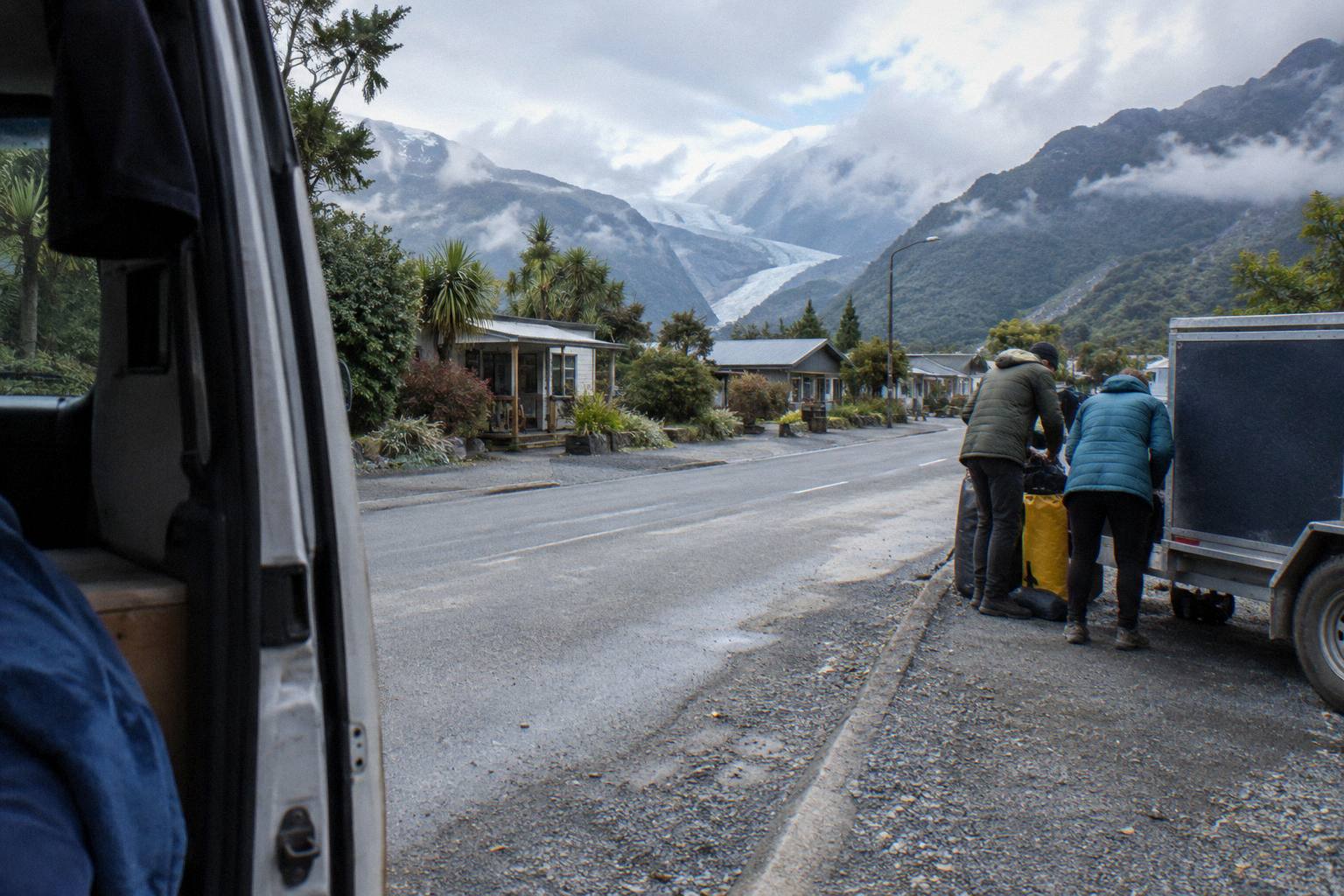
The lagoon's timing quirk matters for planning. Because Okarito Kayaks schedules departures around the best tidal conditions for each day, your start time may shift, and a rain forecast changes nothing about that mechanism. The Explorer runs 3 hours total with up to 2 on the water, from NZ$165 per person; the Adventurer runs 4 hours with up to 3 on the water and needs some fitness and flexibility, from NZ$210 per person. The booking pages exclude people over 200 cm or over 125 kg, and departures need at least two adults to confirm, so a solo traveller should not assume a departure will run.
The full comparison, including how to do both in one trip if you have the days, is in our guide to choosing Lake Mapourika or Okarito Lagoon. For a deeper weather-planning read, see how Franz Josef weather affects kayak tours across the seasons.
A Wet-Forecast Checklist For Your Paddle Day
Check the Windy app for the lake itself rather than the township forecast, lay out quick-dry layers and skip jeans, arrive 15 minutes early, and plan to keep the booking unless you are outside the 24-hour window. Book the 3-hour Mapourika trip early in your stay so an operator cancellation can be rescheduled, and carry your camera regardless of the sky, since reflections are often best under cloud.
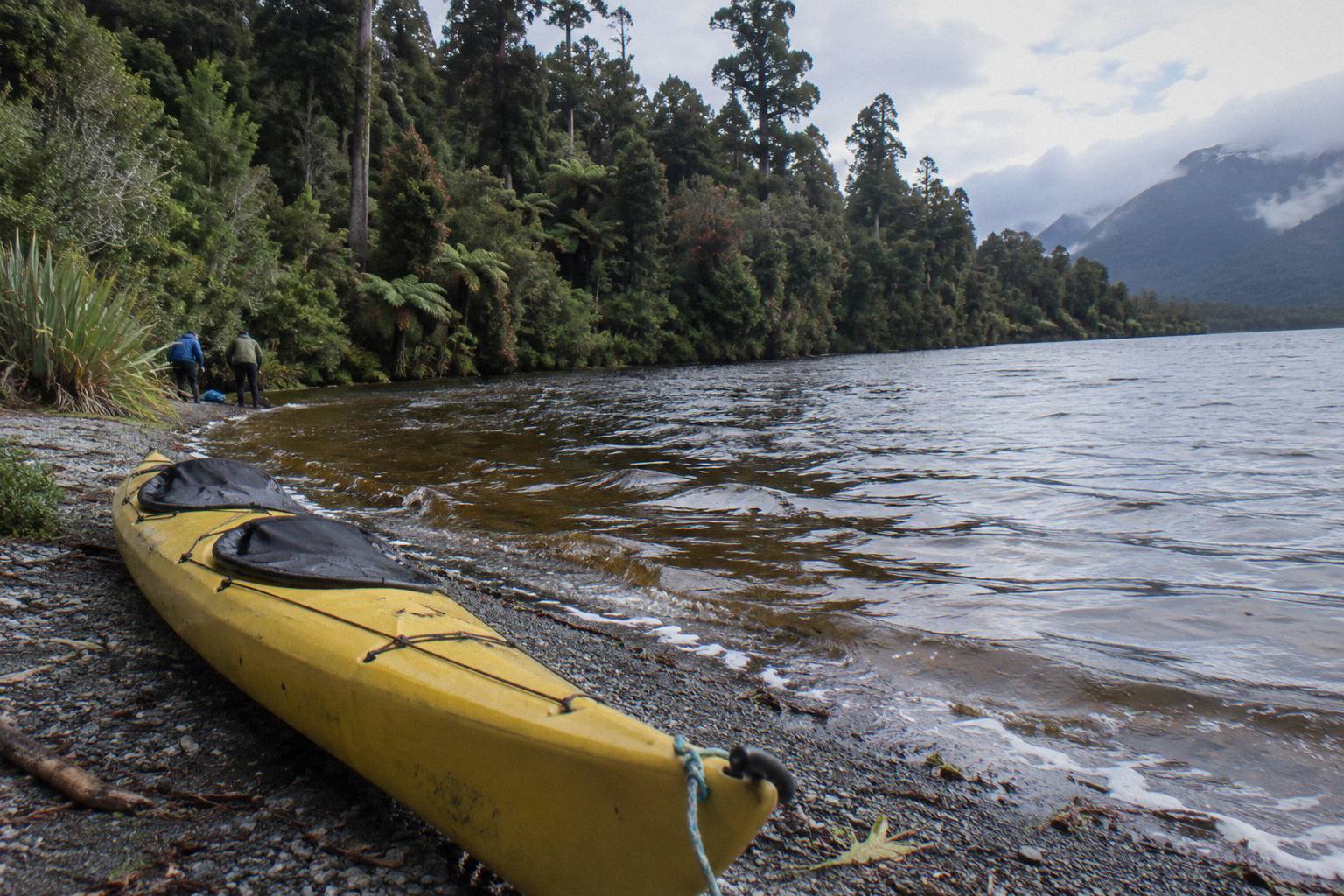
The whole decision compresses into a short sequence. The night before, look at the forecast for the water, not the town, and remember the operator's report that the two often disagree. The morning of, dress in layers you would hike in, not clothes you would sightsee in, and let the supplied gear do the waterproofing. At the office or base, ask the guide directly about conditions: they check them professionally, and they would rather answer a question than launch a nervous group.
| The forecast says | What to do |
|---|---|
| Light rain, little wind | Go; this is the atmospheric mirror day the operator describes |
| Steady rain, calm | Go; gear covers it, reflections often improve |
| Wind and rain together | Ask at check-in; wind is the real safety variable on the lake |
| Township pouring, lake unknown | Check Windy for the lake; the two often differ |
| You are inside 24 hours | The trip runs if safe; a refund applies only to operator cancellation |
Budget-wise, the wet-day options span from the Lake Mapourika Scenic Cruise, from NZ$125 per person for a 2-hour covered-boat trip with a toilet on board, up to the Okarito Adventurer at from NZ$210. Every one of the five carries free cancellation up to 24 hours on the booking page. If rain simply is not your day, the cruise is the dry compromise: same lake, same transfer from the Franz Josef office, roof over the whole experience.
However you go, go. The West Coast rewards the visitors who treat its weather as scenery rather than as an obstacle, and a kayak is one of the best places from which to watch it do its work.
Common Questions About Kayaking In The Rain Near Franz Josef
Do Kayak Tours Near Franz Josef Run When It Rains?
Yes. Franz Josef Wilderness Tours runs its lake trips in wet weather and supplies paddling jackets, PFDs and wet-weather gear, noting that kayaking can be especially atmospheric in light rain. Tours are cancelled only when conditions are considered unsafe, with an alternative or a full refund offered.
What Gear Is Supplied On A Rainy Kayak Tour?
On the Lake Mapourika trips you get a dry bag, paddling jacket, PFD, wet-weather gear, kayak skirt, pogies and paddle, plus free photos emailed afterward. Okarito Kayaks provides a buoyancy aid, spray skirt, dry bags, lagoon map and bird guide, insect repellent, and a rescue boat on standby.
Can I Cancel My Kayak Tour If It Rains?
Yes, if you act in time. A change or cancellation at least 24 hours before departure earns a full refund with no penalty; inside 24 hours the booking is not refundable for any reason, and private or group bookings carry a 48-hour rule. If the operator cancels for unsafe conditions or minimum numbers, you get a full refund.
What Should I Wear Kayaking In The Rain?
Quick-drying warm layers under the supplied gear, a cap, and comfy sneakers or sandals, since the operator says feet stay dry on the lake trips. The one hard rule: no jeans, because wet denim stays cold for hours. At Okarito, bring your own rain jacket and warm quick-drying clothing.
Are The Reflections Better Or Worse In The Rain?
Often better. The operator says mirror-lake reflections are often really dramatic when it is cloudy, because flat overcast light and still air give the tannin-dark surface a glassy look. Glacier views, by contrast, appear only on clear days when cloud is not sitting low in the valley.
Does It Rain A Lot In Franz Josef?
Yes, by any national standard. NIWA records for 1991 to 2020 give a mean annual rainfall of 5,555.2 mm, with every month above 300 mm. October is the wettest month at 594.1 mm and July the driest at 317.8 mm.